
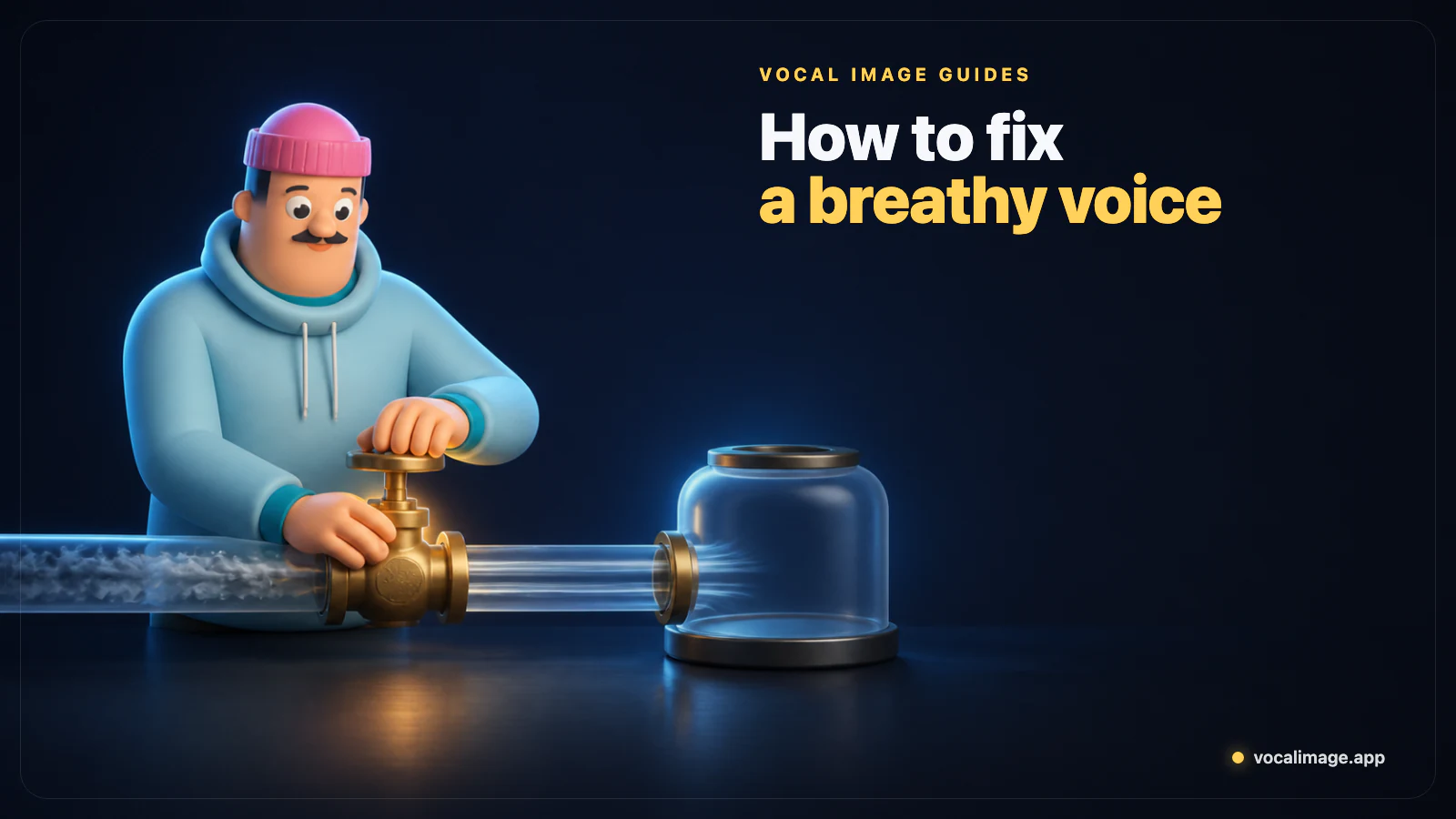
How to Fix a Breathy Voice (and When It's Fine)
A breathy voice is a voice with audible air in it. Your vocal folds don't close completely as they vibrate, so some of the breath escapes as a soft hiss instead of turning into sound. The result is soft, airy or whispery, tires quickly and disappears in a noisy room. A touch of breathiness is normal — many voices have a little, and it can even sound attractive. But if your voice is always airy, runs out of breath mid-sentence or changed suddenly, there is usually a cause you can work on. Here's how to tell, what causes it, and the exercises and habits that help — without surgery or medicine in most cases.
Enchance your
voice with AI
1 minute quizWhat Is a Breathy Voice?
A breathy voice means that air leaks through the vocal folds while you speak or sing. Normally the folds come together with every vibration and turn almost all of the air into sound. When they don't close fully, part of the air passes through unused. People also call it an airy, wispy or breathless voice. When breathiness is persistent and caused by a problem with the vocal folds, doctors describe it as a form of dysphonia (a voice disorder), sometimes called breathy dysphonia.
What it sounds like
Soft and whispery, as if you were speaking on a sigh. The voice lacks ring and power, words at the end of sentences fade, and you need to breathe more often. Marilyn Monroe's famous "Happy Birthday, Mr. President" is the classic example of a deliberately breathy style.
Breathy vs. husky, hoarse and raspy
- Breathy — too much air: soft and whispery.
- Hoarse — rough and strained, often because swollen vocal folds can't vibrate evenly (a cold, overuse).
- Raspy — a rough, grainy texture from irregular vibration.
- Husky — low and breathy, with a little roughness.
Breathiness, hoarseness and rasp often show up together. For the rough-sounding voices, see our guide to the raspy voice.
Is a breathy voice bad?
Not necessarily. A little breath in the voice is common and, in moderation, can even sound attractive. It becomes a problem when it's constant and you can't switch it off, when it makes you hard to hear or understand, when talking tires you, or when it appeared suddenly.
How to Tell If Your Voice Is Too Breathy
- The s/z test. Take a deep breath and sustain "sss" for as long as you can without straining; time it. Rest, then do the same on "zzz". Do each twice and keep the longer time. In a healthy voice the two times are about the same. If your "zzz" is much shorter than your "sss", air may be escaping while your vocal folds vibrate. It's a rough screening tool that speech therapists use, not a diagnosis.
- Record yourself. Read a paragraph aloud and listen: can you hear a hiss of air at the start of words or under the voice?
- Notice your breath. Do you run out of air in the middle of ordinary sentences?
- The noise test. Do people ask you to speak up in cafés or on video calls even when you feel you're talking normally?
What Causes a Breathy Voice?
A breathy voice is usually the result of the vocal folds not closing properly. That can have several causes:
- Habit and technique. The most common cause in healthy people: speaking softly and hesitantly, starting words on a puff of air, or copying a soft speaking style. The folds are healthy — they're just used lightly.
- Muscle tension. Tension in the muscles around the voice box can, surprisingly, also leave a gap between the vocal folds. Releasing throat and larynx tension often helps.
- Vocal fold lesions. Nodules, polyps, cysts and scarring stop the folds from meeting along their whole length. Nodules are common in people who use their voice heavily — teachers, singers, salespeople — and are often linked to overuse ("vocal abuse").
- Vocal fold paresis or paralysis. When a nerve that controls the vocal folds is weakened or damaged — for example after neck or chest surgery or a viral infection — one fold may not close properly. The voice becomes weak and breathy, and some people cough when they drink.
- Aging. With age, the vocal folds can thin and bow slightly, leaving a gap. Doctors call this presbyphonia.
- Swelling and irritation. Laryngitis, reflux, allergies and smoking all affect how evenly the folds vibrate.
- Rarely, a growth. A growth on or near the vocal folds can also cause breathiness — one more reason to get a lasting change checked.
- Your anatomy. A small gap at the back of the vocal folds is common, especially in women, and is usually harmless.
In most cases, a breathy voice can be improved with exercises and voice therapy, without any surgery.
How to Fix a Breathy Voice: 6 Exercises
These exercises help your vocal folds close more completely — without squeezing. Do them gently, 5–10 minutes a day, for two to four weeks. If anything hurts or scratches, stop.
1. Release your neck and shoulders
Start with gentle neck and shoulder rolls to loosen the muscles around your voice box. Tension makes the next exercises harder. If your throat feels tight, use these exercises to release tension in your throat first.
2. Breathe low and slowly
Take a deep breath in through your nose and breathe out slowly through your mouth, keeping your jaw relaxed. Let your belly and lower ribs expand on the in-breath. Good breath support gives the voice a steady stream of air, so you don't have to push extra air through the folds.
3. Hum into "mm-hmm"
Hum on a comfortable note with your lips closed until you feel them buzz. Then say "mm-hmm" as if agreeing with someone, and move on to "mmm-one, mmm-two, mmm-three". Humming helps the folds vibrate efficiently, and the words carry that clear, buzzy quality into speech.
4. The "sss–zzz" switch
Start a steady "sss", then switch to "zzz" without changing the airflow. Aim for a strong, even buzz — not a hissy "z". Then open the buzz into a vowel: "zzz-ah", "zzz-oh". This teaches the folds to close for sound instead of letting air slip through.
5. Straw humming and lip trills
Hum through a drinking straw and glide slowly up and down, or do lip trills: blow air through loosely closed lips so they flutter, then add sound. These "semi-occluded" exercises help the folds vibrate more efficiently, with less effort and less impact, which is why voice therapists use them so often.
6. Clean starts and full phrases
Say words that start with a vowel — "apple, every, open, under" — and start each one cleanly, without a puff of air before the vowel but without a hard click either. Then count from one to ten on one breath in a full, buzzy voice, keeping it steady to the last number. Repeat these exercises several times a day to make clear closure your default.
Daily Habits That Make a Breathy Voice Better (or Worse)
- Drink plenty of fluids. Hydrated vocal folds vibrate more easily. Good options: water, herbal tea, fruit juice without added sugar, vegetable broth.
- Use a humidifier. Dry air dries out the vocal folds, especially in heated or air-conditioned rooms.
- Quit smoking. Smoking irritates the vocal folds and leads to hoarse and breathy voice problems over time. Counseling, medication and support groups can help — talk to your doctor about the best way for you.
- Don't whisper. Whispering for long stretches is tiring for the voice. If you need to rest your voice, rest it — see how to get your voice back.
- Avoid shouting and long talking marathons. Overuse is a common cause of nodules.
- Dairy and coffee: don't overthink them. Milk doesn't make your body produce more mucus: studies found no link, and the "thick" feeling some people notice after milk appeared just as often after a soy drink with a similar texture. If it bothers you, skip milk before an important talk. Moderate coffee — up to about four cups a day — doesn't dehydrate you either: in a study of regular coffee drinkers, it hydrated about as well as water.
- Speak up a little. A slightly fuller, more energetic voice encourages better closure. If you're often asked to repeat yourself, read our guide to a quiet voice.
Breathy Singing: How to Stop It
Some singers use breathiness as a style, and on soft passages it can be beautiful. It becomes a problem when you can't switch it off: notes lack power, phrases run out of air and your voice tires quickly. The fix is the same as for speech — better breath support, straw and lip-trill exercises — plus brighter, more focused vowels. A bratty "nay-nay-nay" on comfortable notes helps you find a clearer sound. Warm up first with our vocal warm-ups, and see our guide to expanding your vocal range for more.
Breathy Voice Treatment: When to See a Doctor
See a doctor — ideally an ENT (laryngologist) — if:
- your voice has been breathy or hoarse for longer than 2–3 weeks;
- it hurts to speak or swallow, you cough up blood or notice a lump in your neck;
- it changed suddenly, or after surgery on your neck or chest or a breathing tube;
- you cough or choke when you drink, or have trouble swallowing or breathing;
- you smoke and your voice has changed.
Treatment depends on the cause. The doctor will first look at your vocal folds with a small camera (laryngoscopy); for most people, treatment then starts with voice therapy with a speech-language pathologist, plus treating reflux or allergies if they play a role. Paralysis and some lesions may need procedures such as vocal fold injections or surgery — your doctor will explain the options.
Track Your Progress
If your voice is still breathy after following these tips for a few weeks, consult a doctor or speech therapist to check for another underlying cause. To hear your progress, record your voice before you start and again after two weeks of exercises. The Vocal Image app has guided exercises to release tension in the muscles around your vocal folds and make your voice stronger — and our free Vocal Image YouTube channel has more tips to take care of your voice at home.
Enchance your
voice with AI
1 minute quizFAQ
It means air escapes through your vocal folds while you speak, because they don't close completely as they vibrate. The voice sounds soft, airy or whispery and often lacks power.
Sources
- Cleveland Clinic — Hoarseness (dysphonia): causes and treatment
- American Speech-Language-Hearing Association (ASHA) — Voice disorders
- Stachler R. J. et al. — Clinical practice guideline: hoarseness (dysphonia) (update). Otolaryngology–Head and Neck Surgery, 2018
- Titze I. R. — Voice training and therapy with a semi-occluded vocal tract: rationale and scientific underpinnings. Journal of Speech, Language, and Hearing Research, 2006
- Wüthrich B. et al. — Milk consumption does not lead to mucus production or occurrence of asthma. Journal of the American College of Nutrition, 2005
- Killer S. C., Blannin A. K., Jeukendrup A. E. — No evidence of dehydration with moderate daily coffee intake. PLoS ONE, 2014
Explore more articles
Explore more challenges
Explore more voice tests
