
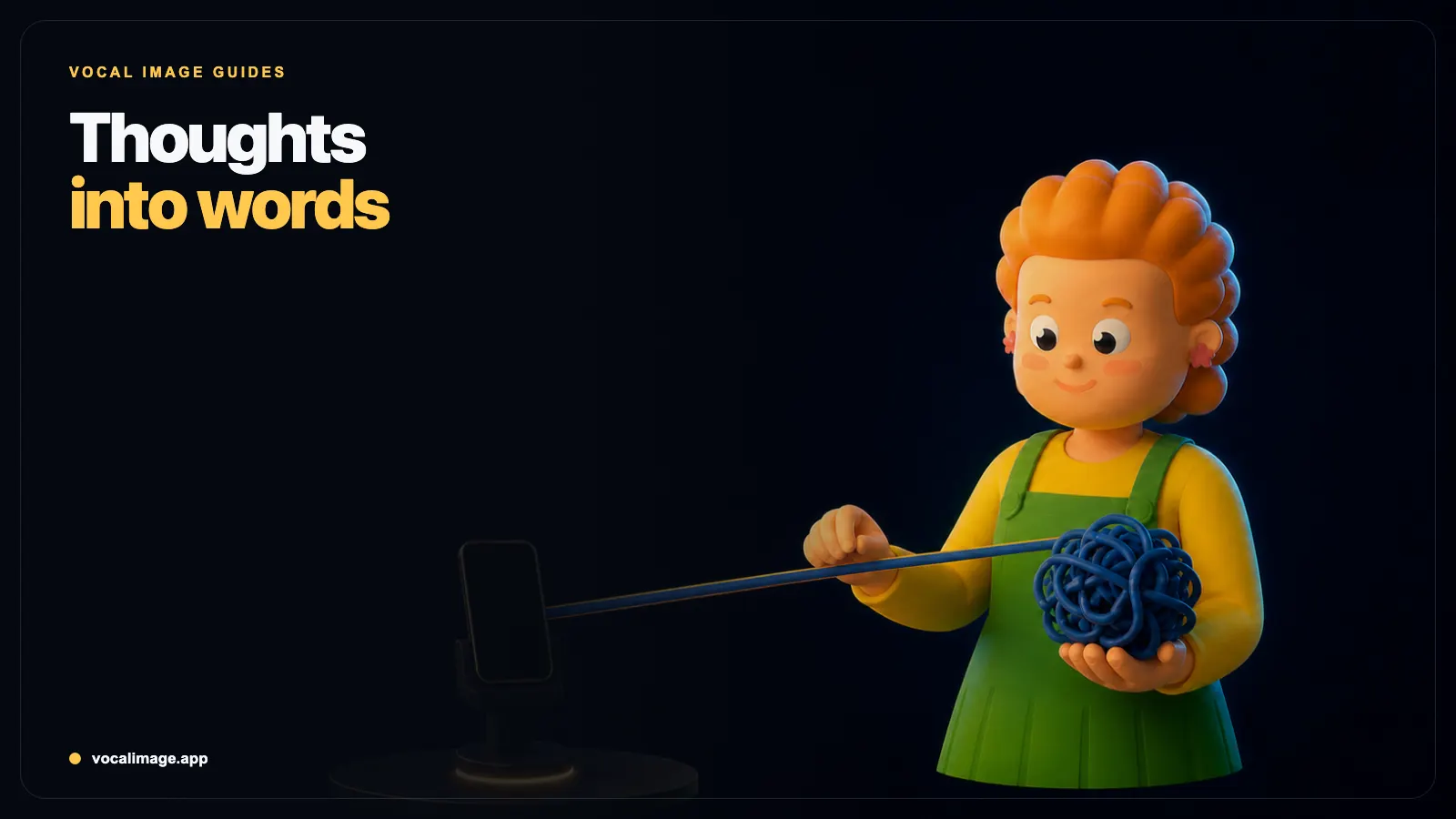
How to articulate thoughts into words
The thought is complete in your head. Sharp, even. Then you start talking and watch it fall apart in real time — wrong first word, a detour, a rebuild, and by the end you're explaining the explanation. "I know what I mean, I just can't say it."
The diagnosis matters, because it's good news: this is not how smart you are. It's the speed gap between two systems — thinking, which works in parallel webs of meaning, and speech, which needs one word at a time in a straight line. Turning a web into a line is a conversion step, and the conversion step is trainable.
Why the conversion fails
- You start speaking before choosing the endpoint. The sentence has no destination, so it wanders. Listeners hear rambling; you feel it as "messy".
- You draft out loud. Restarts ("what I mean is—", "okay, so basically—") are your editor working in public.
- You aim for the perfect word and stall retrieval. In speech, the second-best word on time beats the perfect word two seconds late — hesitation costs more credibility than plainness.
The conversion drill (the core 3 minutes of your day)
- Endpoint first. Before speaking, name the last thing you'll say — silently, three words max ("ship it Friday"). Now the sentence has a destination.
- Three-sentence cap. Say the thought in exactly three sentences: claim → reason → example. Out loud, recorded, no restarts allowed. If you restart, the rep doesn't count — that rule alone kills the drafting habit within a week.
- Shrink it. Same thought, one sentence. Compression forces word choice, which is retrieval training in disguise.
Grab material anywhere: the film you watched, the bug you fixed, why lunch was disappointing. Three thoughts a day, out loud. Silent rehearsal doesn't count — the conversion only trains when the mouth is involved.
The pressure layer
Calm-room skill breaks under stress unless you train with a clock. Add a 60-second timer, or use recording itself as the stressor — the speech test both applies the pressure and scores the result: pace, clarity, fillers. Your baseline number, then the weekly trend. (If pressure doesn't just muddle you but wipes the slate blank mid-sentence, that's a specific mechanism with its own fix — mind goes blank.)
What to expect
Week one: the three-sentence cap feels tight, restarts sting. Week two: the endpoint habit starts firing on its own in real conversations — you'll notice you finish sentences more often than you abandon them. Week three onward: people stop hearing you think and start hearing what you thought. The full daily routine this slots into is on the articulate hub.
How confident do you actually sound?
Speak for 30 seconds — AI scores your pace, clarity, and filler words. Free, no sign-up.
FAQ
Writing lets you draft invisibly — you edit before anyone sees. Speaking publishes the draft. The drill above moves the editing before the sentence starts, which is what fluent speakers do without noticing.
Explore more articles
Explore more challenges
Explore more voice tests
