
Minimal pairs: 96 examples to train your English ear and mouth
Short answer: minimal pairs are two words that differ in just one sound, like ship and sheep or think and sink. Because only that sound changes the meaning, they are the fastest way to check whether you hear and say an English sound correctly. Below are 96 examples of minimal pairs in 12 groups, with IPA for every word, practice sentences and a printable PDF.
How to use the tables: read each pair out loud, left word then right word, and make the difference audible. If a friend, or an app, can't tell which word you said, that's the sound to work on. The IPA is American English, as in a learner's dictionary.
What are minimal pairs?
A minimal pair is two words with the same sounds except one, in the same position: pin and bin differ only in the first sound, bad and bed only in the vowel. Linguists use them to prove that two sounds are separate in a language: if swapping the sound changes the word, the difference matters.
For learners, that turns into a simple test. Spanish has one sound where English has /ɪ/ and /iː/, so ship and sheep can come out the same. Japanese has one sound where English has R and L, so right and light can merge. Minimal pairs show you exactly which contrasts your first language hides from you, and give you a short, focused way to practice them.
Speech-language pathologists also use minimal pairs with children who mix up sounds. This page is about the English contrasts that learners and accent-trainers work on.
Vowel minimal pairs
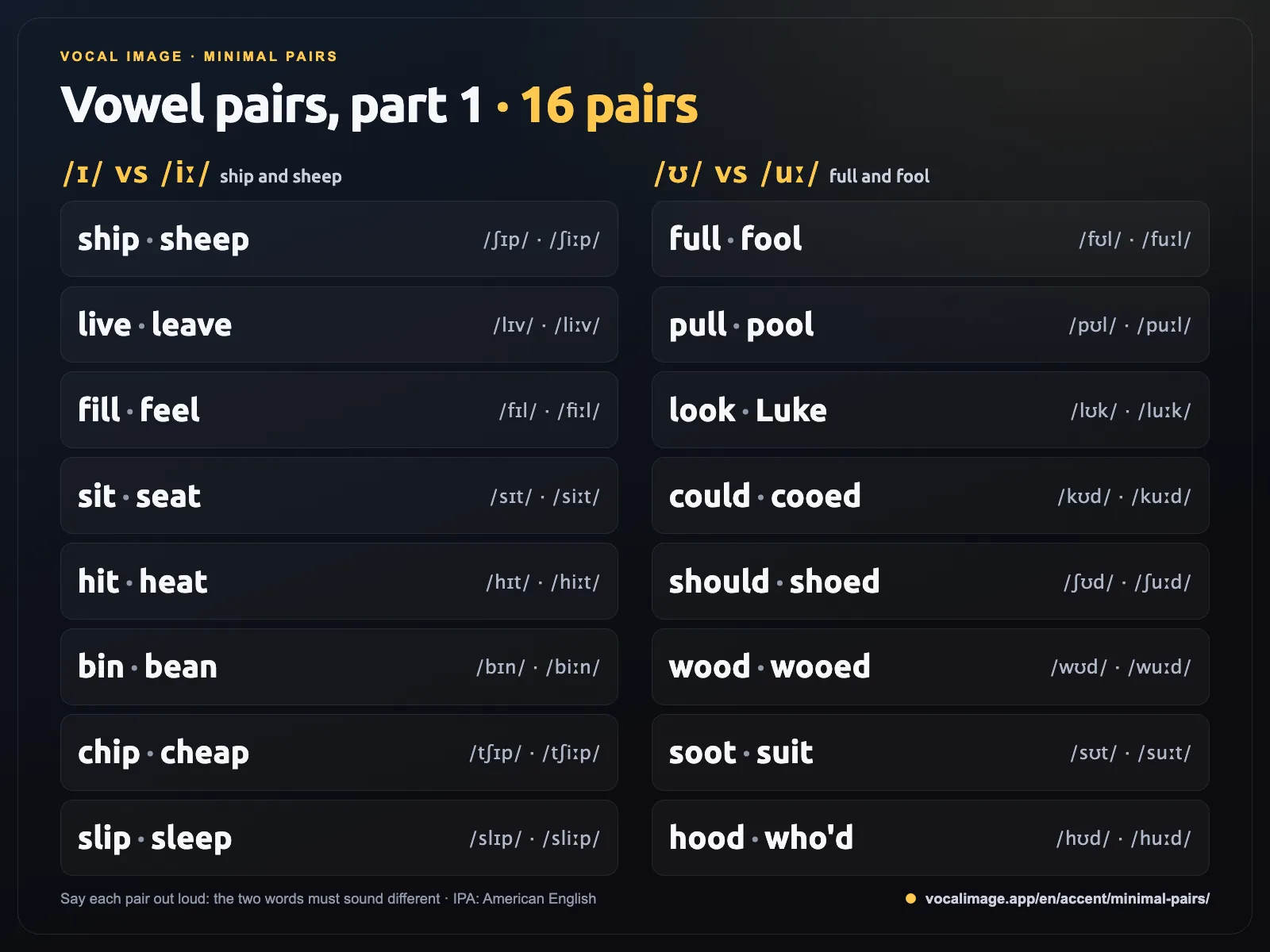
/ɪ/ vs /iː/: ship and sheep
The short /ɪ/ is relaxed and quick; the long /iː/ is tense, with spread lips, and held a little longer.
| /ɪ/ as in ship | /iː/ as in sheep |
|---|---|
| ship /ʃɪp/ | sheep /ʃiːp/ |
| live /lɪv/ | leave /liːv/ |
| fill /fɪl/ | feel /fiːl/ |
| sit /sɪt/ | seat /siːt/ |
| hit /hɪt/ | heat /hiːt/ |
| bin /bɪn/ | bean /biːn/ |
| chip /tʃɪp/ | cheap /tʃiːp/ |
| slip /slɪp/ | sleep /sliːp/ |
/ʊ/ vs /uː/: full and fool
For /ʊ/ the lips are only slightly rounded and the sound is short; for /uː/ they are tightly rounded and the sound is long.
| /ʊ/ as in full | /uː/ as in fool |
|---|---|
| full /fʊl/ | fool /fuːl/ |
| pull /pʊl/ | pool /puːl/ |
| look /lʊk/ | Luke /luːk/ |
| could /kʊd/ | cooed /kuːd/ |
| should /ʃʊd/ | shoed /ʃuːd/ |
| wood /wʊd/ | wooed /wuːd/ |
| soot /sʊt/ | suit /suːt/ |
| hood /hʊd/ | who'd /huːd/ |
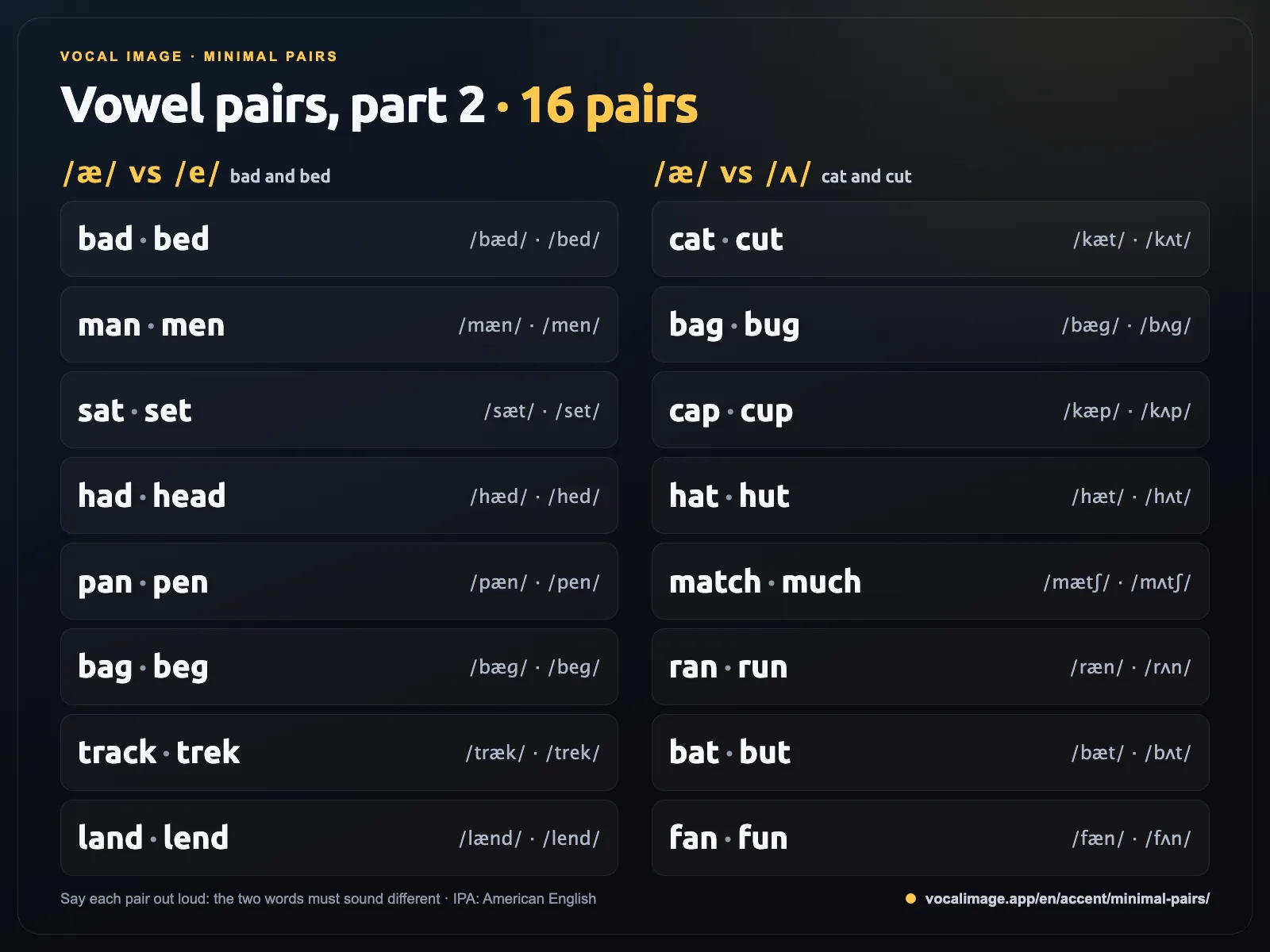
/æ/ vs /e/: bad and bed
/æ/ needs a wider mouth and a lower jaw; /e/ is halfway between it and /ɪ/.
| /æ/ as in bad | /e/ as in bed |
|---|---|
| bad /bæd/ | bed /bed/ |
| man /mæn/ | men /men/ |
| sat /sæt/ | set /set/ |
| had /hæd/ | head /hed/ |
| pan /pæn/ | pen /pen/ |
| bag /bæɡ/ | beg /beɡ/ |
| track /træk/ | trek /trek/ |
| land /lænd/ | lend /lend/ |
/æ/ vs /ʌ/: cat and cut
/æ/ is made at the front of the mouth with the lips spread; /ʌ/ is a short, central "uh".
| /æ/ as in cat | /ʌ/ as in cut |
|---|---|
| cat /kæt/ | cut /kʌt/ |
| bag /bæɡ/ | bug /bʌɡ/ |
| cap /kæp/ | cup /kʌp/ |
| hat /hæt/ | hut /hʌt/ |
| match /mætʃ/ | much /mʌtʃ/ |
| ran /ræn/ | run /rʌn/ |
| bat /bæt/ | but /bʌt/ |
| fan /fæn/ | fun /fʌn/ |
TH minimal pairs
TH is the sound learners replace most often, and what it turns into depends on the first language: S, T, F or D. Put the tip of the tongue lightly between or against the teeth and let the air pass over it.
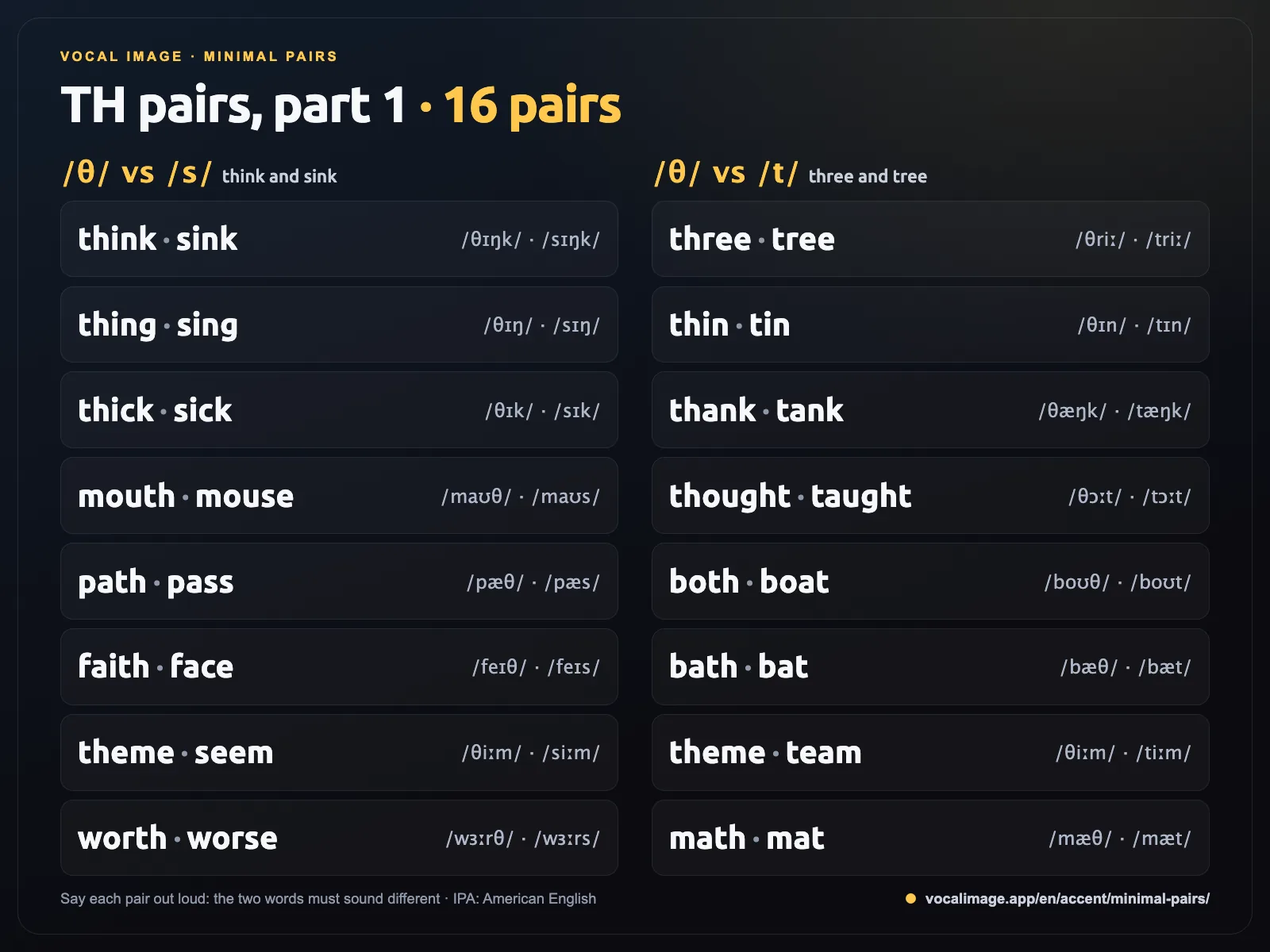
/θ/ vs /s/: think and sink
| /θ/ as in think | /s/ as in sink |
|---|---|
| think /θɪŋk/ | sink /sɪŋk/ |
| thing /θɪŋ/ | sing /sɪŋ/ |
| thick /θɪk/ | sick /sɪk/ |
| mouth /maʊθ/ | mouse /maʊs/ |
| path /pæθ/ | pass /pæs/ |
| faith /feɪθ/ | face /feɪs/ |
| theme /θiːm/ | seem /siːm/ |
| worth /wɜːrθ/ | worse /wɜːrs/ |
/θ/ vs /t/: three and tree
| /θ/ as in three | /t/ as in tree |
|---|---|
| three /θriː/ | tree /triː/ |
| thin /θɪn/ | tin /tɪn/ |
| thank /θæŋk/ | tank /tæŋk/ |
| thought /θɔːt/ | taught /tɔːt/ |
| both /boʊθ/ | boat /boʊt/ |
| bath /bæθ/ | bat /bæt/ |
| theme /θiːm/ | team /tiːm/ |
| math /mæθ/ | mat /mæt/ |
/θ/ vs /f/: three and free
| /θ/ as in three | /f/ as in free |
|---|---|
| three /θriː/ | free /friː/ |
| thought /θɔːt/ | fought /fɔːt/ |
| thirst /θɜːrst/ | first /fɜːrst/ |
| death /deθ/ | deaf /def/ |
| Ruth /ruːθ/ | roof /ruːf/ |
| thin /θɪn/ | fin /fɪn/ |
| oath /oʊθ/ | oaf /oʊf/ |
| thrill /θrɪl/ | frill /frɪl/ |
/ð/ vs /d/: then and den
The voiced TH, /ð/, is the same tongue position as /θ/ with the voice on: you should feel a buzz.
| /ð/ as in then | /d/ as in den |
|---|---|
| then /ðen/ | den /den/ |
| they /ðeɪ/ | day /deɪ/ |
| there /ðer/ | dare /der/ |
| those /ðoʊz/ | doze /doʊz/ |
| though /ðoʊ/ | dough /doʊ/ |
| breathe /briːð/ | breed /briːd/ |
| worthy /ˈwɜːrði/ | wordy /ˈwɜːrdi/ |
| lather /ˈlæðər/ | ladder /ˈlædər/ |
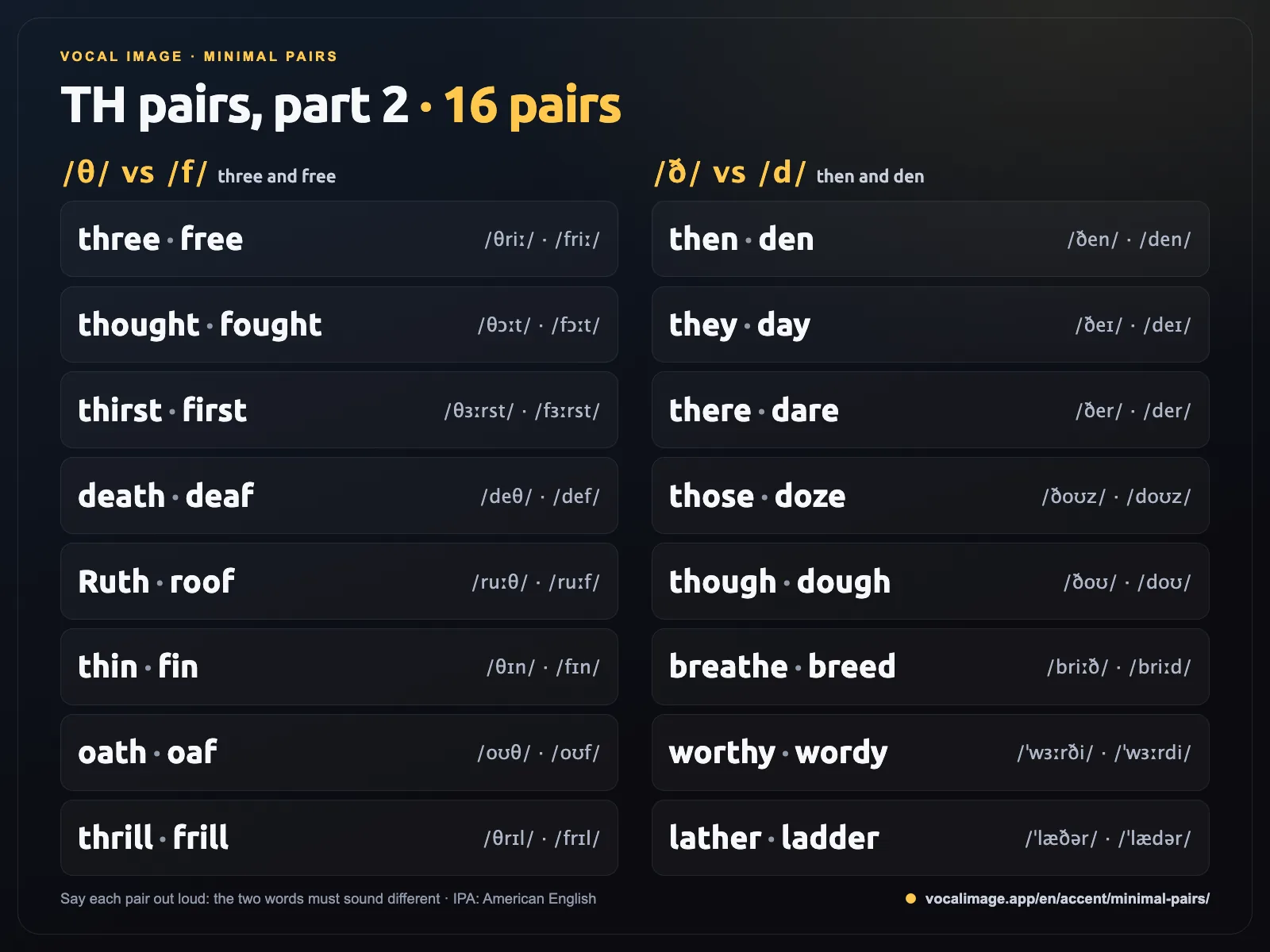
For a step-by-step guide to the tongue position, see how to pronounce the TH sound and the TH tongue twisters.
Wondering which sounds give your accent away? Take the free accent test
15 secR and L, B, V and W minimal pairs
/r/ vs /l/: right and light
For R the tongue tip doesn't touch anything; for L it presses on the ridge behind the top teeth.
| /r/ as in right | /l/ as in light |
|---|---|
| right /raɪt/ | light /laɪt/ |
| rock /rɑːk/ | lock /lɑːk/ |
| road /roʊd/ | load /loʊd/ |
| rice /raɪs/ | lice /laɪs/ |
| fry /fraɪ/ | fly /flaɪ/ |
| grass /ɡræs/ | glass /ɡlæs/ |
| correct /kəˈrekt/ | collect /kəˈlekt/ |
| pray /preɪ/ | play /pleɪ/ |
/v/ vs /b/ and /v/ vs /w/: very, berry and wine
For V the top teeth touch the lower lip. For B both lips close; for W they round and don't touch the teeth.
| /v/ as in very | /b/ as in berry or /w/ as in wine |
|---|---|
| very /ˈveri/ | berry /ˈberi/ |
| vote /voʊt/ | boat /boʊt/ |
| van /væn/ | ban /bæn/ |
| curve /kɜːrv/ | curb /kɜːrb/ |
| vine /vaɪn/ | wine /waɪn/ |
| vest /vest/ | west /west/ |
| vet /vet/ | wet /wet/ |
| verse /vɜːrs/ | worse /wɜːrs/ |
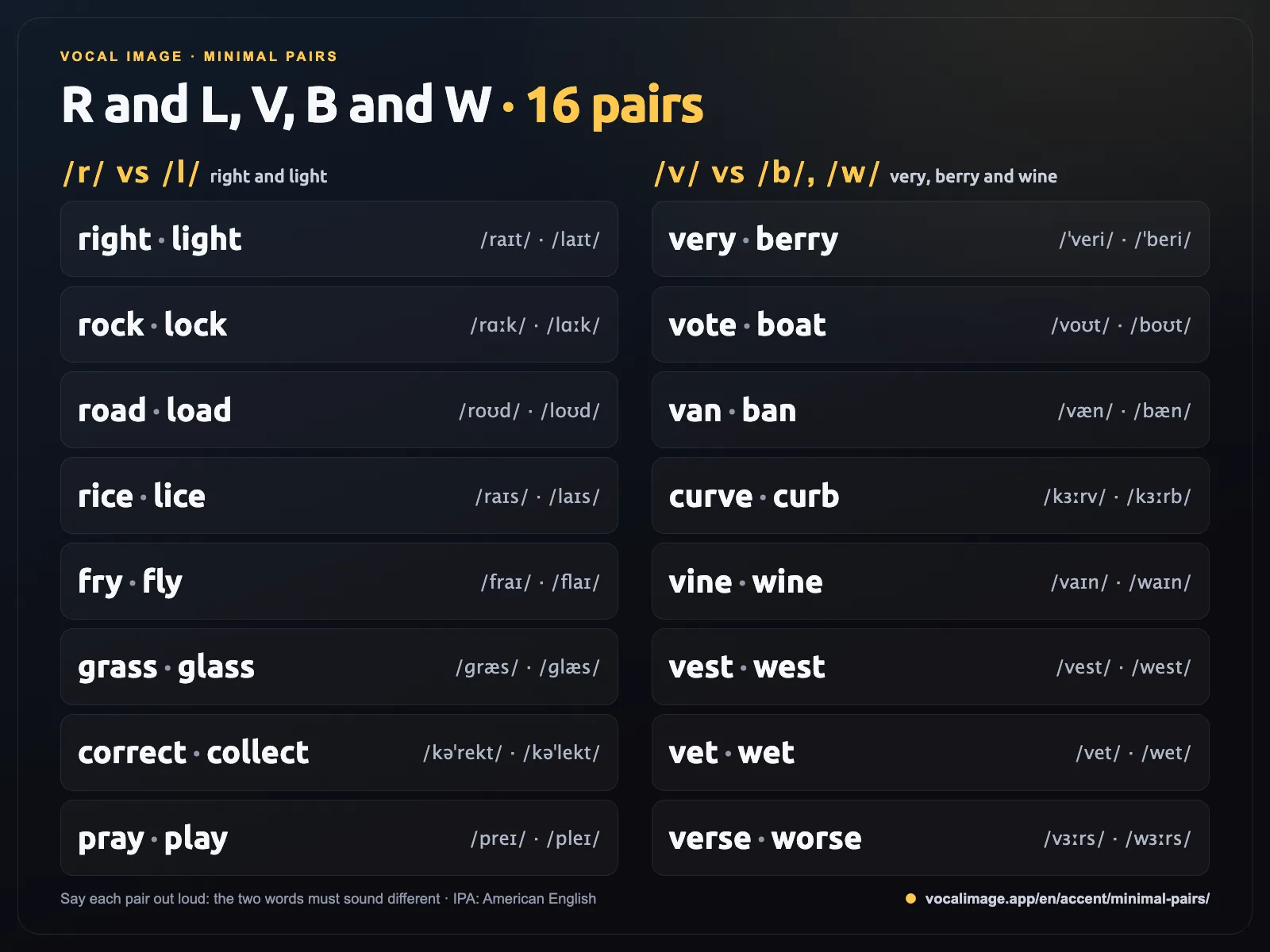
More practice: R, L, V and W tongue twisters.
P and B, S and SH minimal pairs
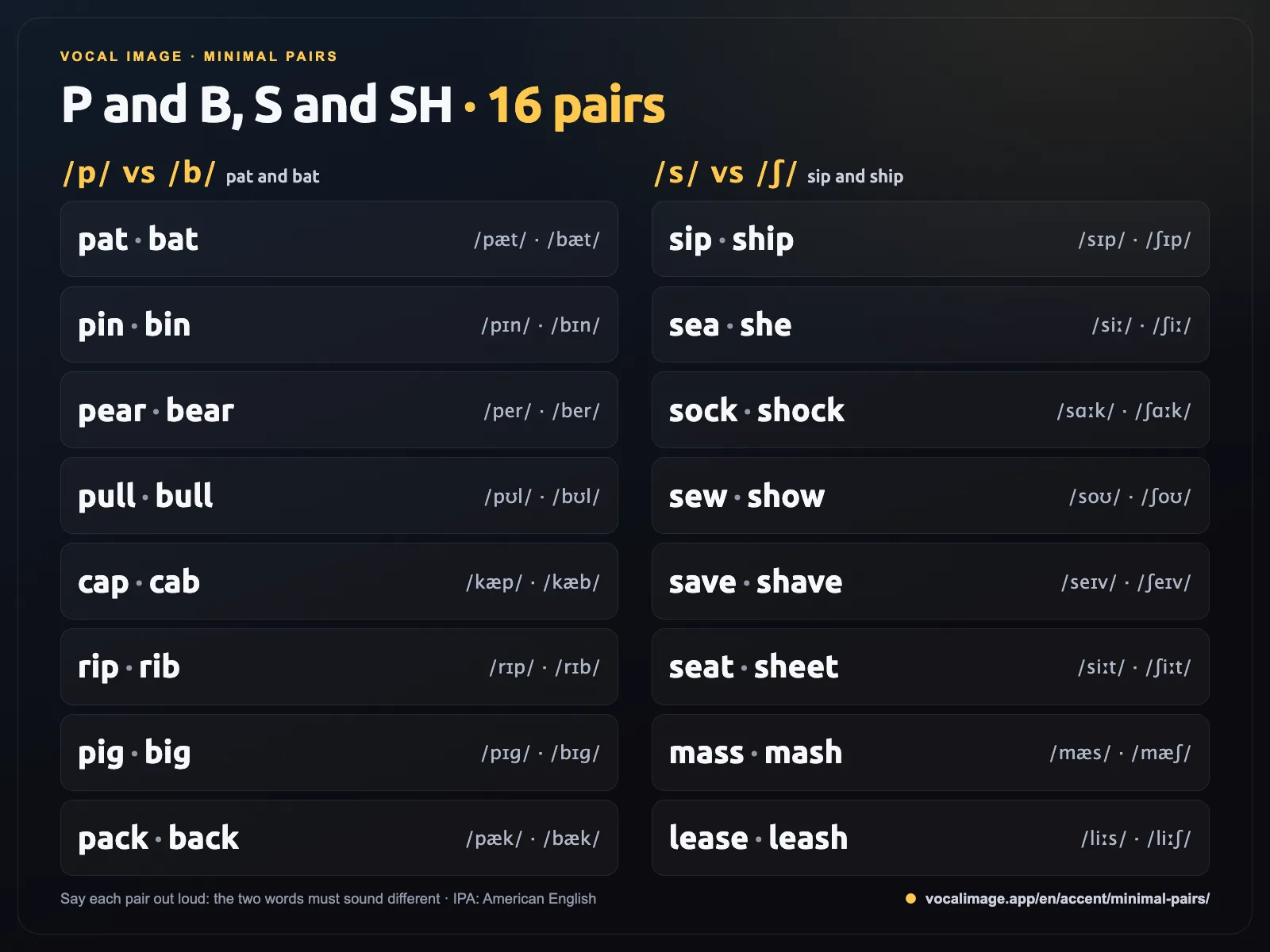
/p/ vs /b/: pat and bat
English P at the start of a word comes with a small puff of air; B has none and uses the voice. Hold a hand in front of your mouth to feel the difference.
| /p/ as in pat | /b/ as in bat |
|---|---|
| pat /pæt/ | bat /bæt/ |
| pin /pɪn/ | bin /bɪn/ |
| pear /per/ | bear /ber/ |
| pull /pʊl/ | bull /bʊl/ |
| cap /kæp/ | cab /kæb/ |
| rip /rɪp/ | rib /rɪb/ |
| pig /pɪɡ/ | big /bɪɡ/ |
| pack /pæk/ | back /bæk/ |
/s/ vs /ʃ/: sip and ship
For SH the lips push forward and the tongue pulls back a little; S is made further forward, with spread lips.
| /s/ as in sip | /ʃ/ as in ship |
|---|---|
| sip /sɪp/ | ship /ʃɪp/ |
| sea /siː/ | she /ʃiː/ |
| sock /sɑːk/ | shock /ʃɑːk/ |
| sew /soʊ/ | show /ʃoʊ/ |
| save /seɪv/ | shave /ʃeɪv/ |
| seat /siːt/ | sheet /ʃiːt/ |
| mass /mæs/ | mash /mæʃ/ |
| lease /liːs/ | leash /liːʃ/ |
Minimal pairs in sentences
Once single words are easy, put both words of a pair in one sentence. These are harder, because your mouth has to switch sounds at speed:
- Don't sit in that seat. (/ɪ/ vs /iː/)
- The full pool made him look a fool. (/ʊ/ vs /uː/)
- The men left the man a note. (/e/ vs /æ/)
- I think the sink is leaking. (/θ/ vs /s/)
- All three of them climbed the tree. (/θ/ vs /t/)
- They walked all day. (/ð/ vs /d/)
- Turn right at the traffic light. (/r/ vs /l/)
- This wine comes from a very old vine. (/w/ vs /v/)
- Put the pear next to the teddy bear. (/p/ vs /b/)
- She will sell her shell collection. (/s/ vs /ʃ/)
Which minimal pairs are hard for you?
Your first language decides which pairs sound the same to you. Start with the rows for your language:
| First language | Pairs to practice first |
|---|---|
| Spanish | /ɪ/–/iː/ (ship, sheep), /b/–/v/ (berry, very), /θ/–/s/ or /θ/–/t/, /s/–/ʃ/ |
| Portuguese | /ɪ/–/iː/, /θ/–/f/ and /θ/–/t/, /æ/–/e/ |
| Japanese | /r/–/l/, /b/–/v/, /θ/–/s/, /s/–/ʃ/ before an "ee" sound |
| Korean | /r/–/l/, /p/–/f/ (pan, fan), /b/–/v/, /ɪ/–/iː/ |
| Mandarin Chinese | /θ/–/s/, /ð/–/d/, /r/–/l/, /ɪ/–/iː/ |
| Arabic | /p/–/b/, /v/–/f/ (van, fan), /ɪ/–/e/ (pin, pen) |
| Russian, Ukrainian, Polish | /ɪ/–/iː/, /æ/–/e/, /v/–/w/, /θ/–/s/ |
| German | /v/–/w/, /θ/–/s/, /æ/–/e/ |
| French | /θ/–/s/, /ð/–/z/ (breathe, breeze), /ɪ/–/iː/ |
The accent reduction guide has a full plan for each language, and 60 hard words to pronounce puts these sounds into real words.
How to practice minimal pairs
- Listen first. Ask someone to read random words from one table while you point to the word you hear. You can't say a difference you can't hear yet.
- Exaggerate, then relax. Make the difference too big at first: an extra-long /iː/, an extra-wide /æ/. Then bring it back to normal.
- Use a mirror. Many contrasts are visible: lips for /v/ and /w/, the tongue for /θ/.
- Go from words to sentences. When a pair is easy in isolation, switch to the sentences above.
- Record and compare. Your own ear forgives you while you speak. A recording, or a free accent test, doesn't.
Five minutes a day on one or two pairs works better than an hour once a week.
Printable minimal pairs list
Download all 96 minimal pairs as a PDF: 12 groups with IPA, on printable pages with a box to tick for each pair you can say clearly.
Related guides: commonly mispronounced words, American accent training, and the English accents hub. If you're working on the R sound, our list of vocalic R words has more practice.
Can people hear the difference when you speak?
Read one short phrase — AI names your accent and the sounds that give it away. Free, no sign-up.
FAQ
Two words that differ in only one sound, in the same position, such as ship and sheep or pin and bin. Because that single sound changes the meaning, a minimal pair proves that the two sounds are different in the language.
Sources
- Wikipedia — Minimal pair
- Oxford Learner's Dictionaries — American English pronunciations, used for the IPA on this page
Explore more articles
Explore more challenges
Explore more voice tests
