
60 hard words to pronounce in English (and how to say each one)
Short answer: the hardest English words to pronounce are rarely the longest ones. Most hard-to-pronounce words fall into three traps: spelling that lies about the sound (colonel, Worcestershire), too many consonants in a row (sixth, strengths) and stress that moves (photograph → photographer). Below are 60 difficult words to pronounce in six groups, each with IPA, an easy respelling and the mistake to avoid. There's a printable PDF at the end.
How to read the tables: CAPITALS mark the stressed syllable (very long words have more than one, and the ˈ mark in the IPA shows the main one), and the IPA is American English, as you'd find it in a learner's dictionary. Where British English is noticeably different, it's noted. For everyday words that people say wrong out of habit, like espresso or nuclear, see 45 commonly mispronounced words.
Silent letters: the letters you don't say
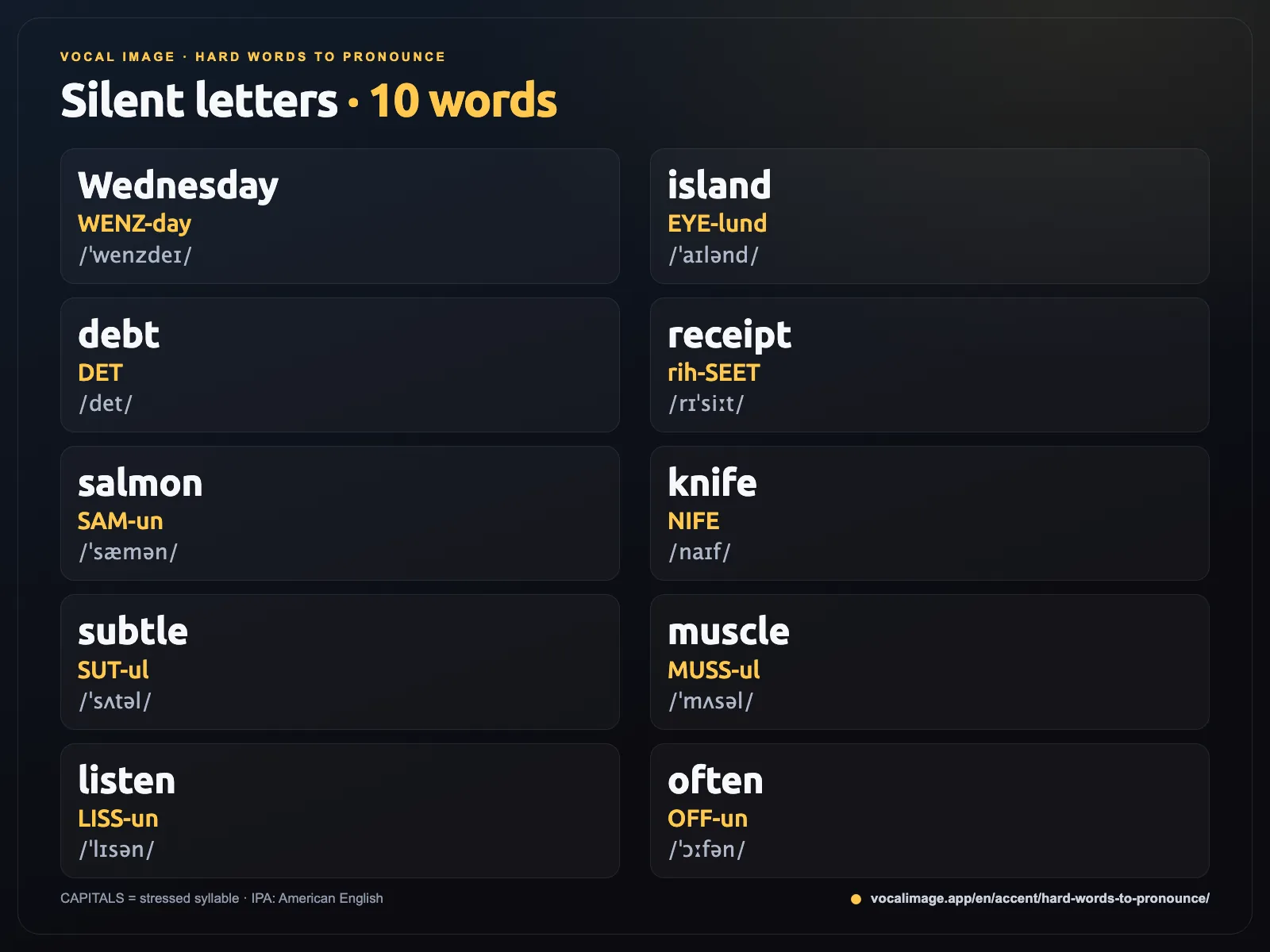
English kept the spelling of words long after it stopped saying some of their letters. A k before n, a b after m or before t, the t in -sten and -stle: written, never spoken.
| Word | IPA (US) | Say it like | Common slip |
|---|---|---|---|
| Wednesday | /ˈwenzdeɪ/ | WENZ-day | three syllables: "wed-nes-day" |
| island | /ˈaɪlənd/ | EYE-lund | saying the S |
| debt | /det/ | DET | saying the B |
| receipt | /rɪˈsiːt/ | rih-SEET | saying the P |
| salmon | /ˈsæmən/ | SAM-un | saying the L |
| knife | /naɪf/ | NIFE | saying the K |
| subtle | /ˈsʌtəl/ | SUT-ul | saying the B |
| muscle | /ˈmʌsəl/ | MUSS-ul | "mus-kul" |
| listen | /ˈlɪsən/ | LISS-un | saying the T |
| often | /ˈɔːfən/ | OFF-un | none: "OFF-tun" is correct too |
The -ough trap: one spelling, half a dozen sounds
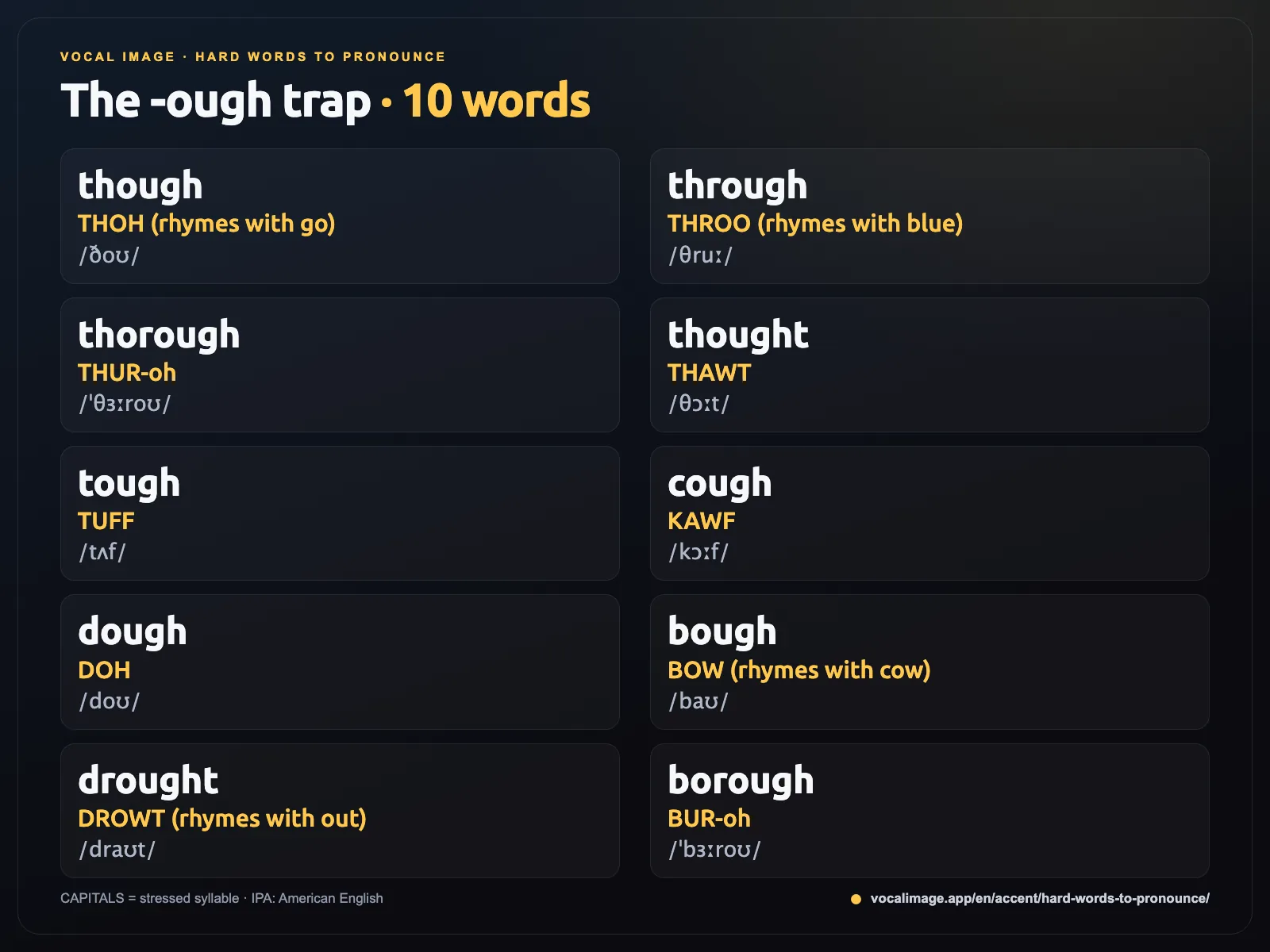
No other spelling in English misleads like -ough. Learn these ten as separate words rather than looking for a rule, because there isn't one.
| Word | IPA (US) | Say it like | Common slip |
|---|---|---|---|
| though | /ðoʊ/ | THOH (rhymes with go) | reading it like "through" |
| through | /θruː/ | THROO (rhymes with blue) | "throw" or "thruff" |
| thorough | /ˈθɜːroʊ/ | THUR-oh | mixing it up with "through"; British: THUH-ruh |
| thought | /θɔːt/ | THAWT | "tot": the TH turned into T |
| tough | /tʌf/ | TUFF | "toe" |
| cough | /kɔːf/ | KAWF | "cow" |
| dough | /doʊ/ | DOH | "duff" |
| bough | /baʊ/ | BOW (rhymes with cow) | "buff" or "bo" |
| drought | /draʊt/ | DROWT (rhymes with out) | "drawt", read like "thought" |
| borough | /ˈbɜːroʊ/ | BUR-oh | "borrow"; British: BUH-ruh |
TH and consonant clusters: too many sounds in a row
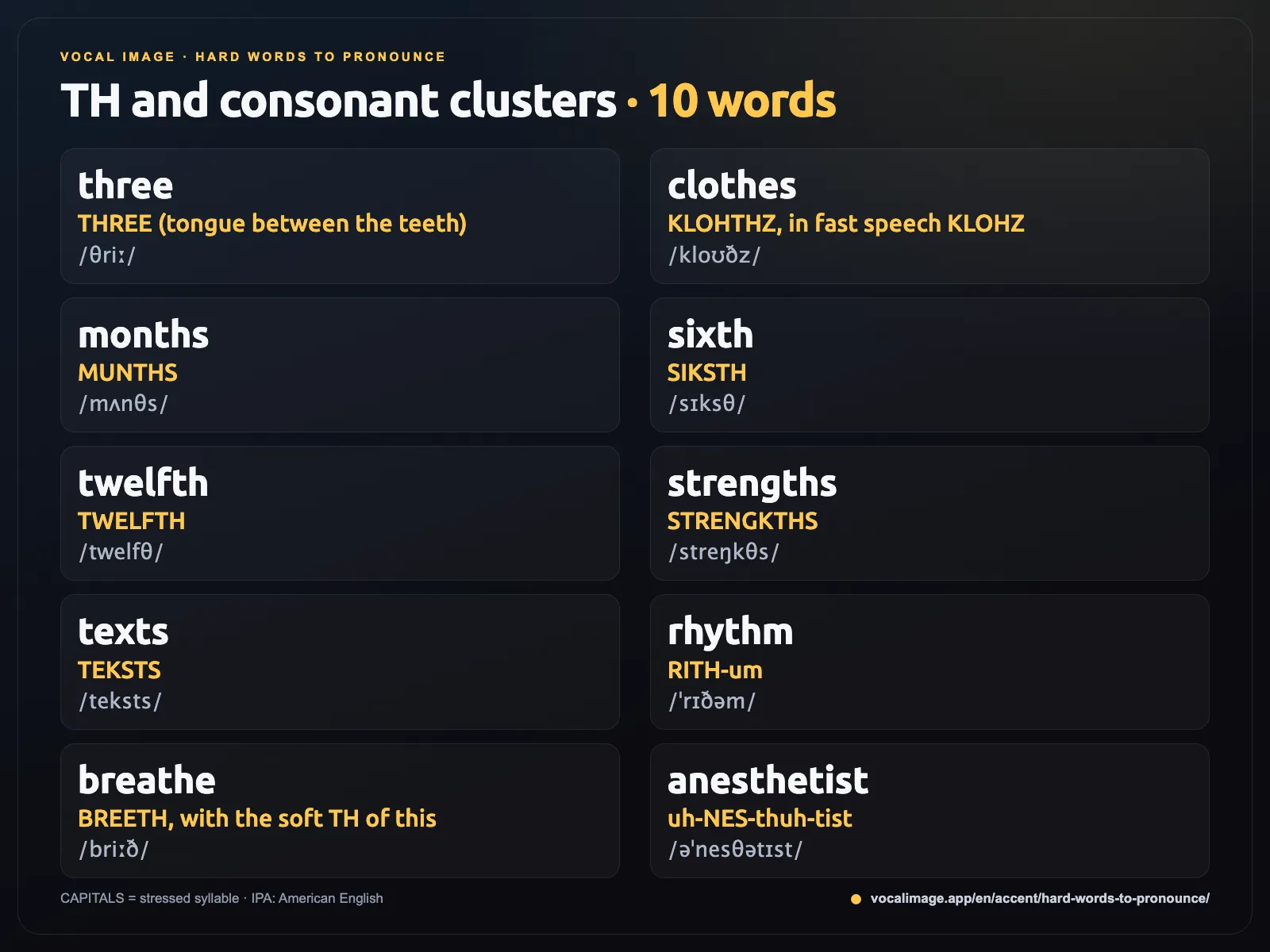
For most learners this is the hardest group. Many languages have no TH at all, and many don't stack three or four consonants after a vowel the way sixths (/sɪksθs/) does. Slow down here: every consonant counts, but none of them gets a vowel.
| Word | IPA (US) | Say it like | Common slip |
|---|---|---|---|
| three | /θriː/ | THREE (tongue between the teeth) | "tree" or "free" |
| clothes | /kloʊðz/ | KLOHTHZ, in fast speech KLOHZ | two syllables: "clo-thes" |
| months | /mʌnθs/ | MUNTHS | "monts" or "mont" |
| sixth | /sɪksθ/ | SIKSTH | "sikst" or "siks" |
| twelfth | /twelfθ/ | TWELFTH | "twelf" |
| strengths | /streŋkθs/ | STRENGKTHS | "strengs", or "e-strengths" |
| texts | /teksts/ | TEKSTS | "teks" or "tek-sez" |
| rhythm | /ˈrɪðəm/ | RITH-um | "rit-mus" |
| breathe | /briːð/ | BREETH, with the soft TH of this | saying "breath" /breθ/ |
| anesthetist | /əˈnesθətɪst/ | uh-NES-thuh-tist | swapping the S and the TH |
For the tongue position, see the TH tongue twisters and our guide to the TH sound in American English, or watch the short lesson below.
Curious which accent people hear in your English? Take the free accent test
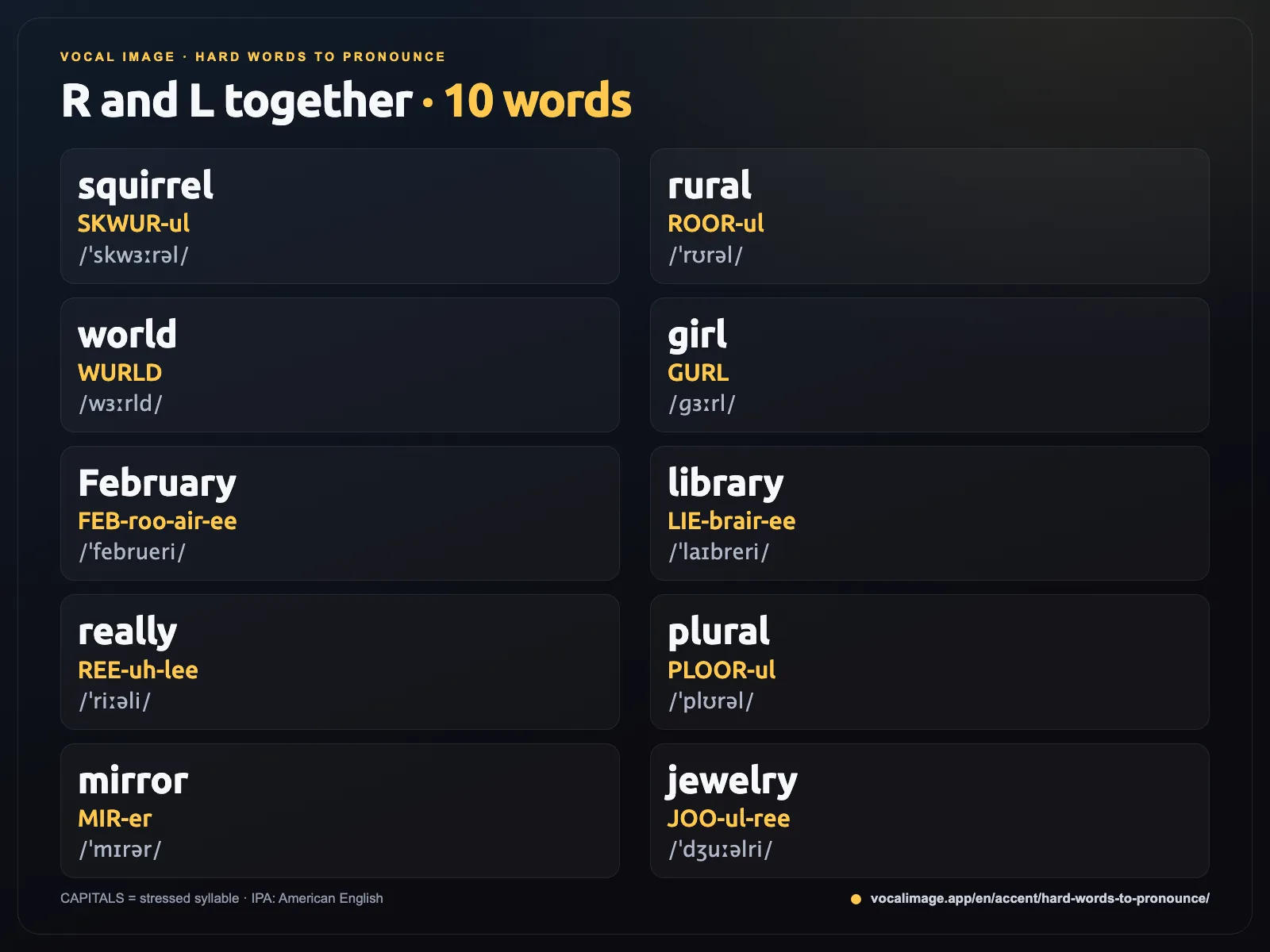
15 secR and L in the same breath
R and L are two separate sounds in English and one sound, or a different pair, in Japanese, Korean and several other languages. Put them next to each other, as in rural or really, and even native speakers slow down.
| Word | IPA (US) | Say it like | Common slip |
|---|---|---|---|
| squirrel | /ˈskwɜːrəl/ | SKWUR-ul | "skwi-rel"; British: SKWIR-ul |
| rural | /ˈrʊrəl/ | ROOR-ul | swallowing the middle: "rul" |
| world | /wɜːrld/ | WURLD | "word" or "vorld" |
| girl | /ɡɜːrl/ | GURL | "gel" or "ger-ul" |
| February | /ˈfebrueri/ | FEB-roo-air-ee | none: "FEB-yoo-air-ee" is standard too |
| library | /ˈlaɪbreri/ | LIE-brair-ee | "lie-berry", dropping the first R |
| really | /ˈriːəli/ | REE-uh-lee | R said as L: "leally" |
| plural | /ˈplʊrəl/ | PLOOR-ul | a full A at the end: "ploo-RAL" |
| mirror | /ˈmɪrər/ | MIR-er | "mee-ROAR" |
| jewelry | /ˈdʒuːəlri/ | JOO-ul-ree | sounds swapped: "JOO-luh-ree" |
More R and L practice: R tongue twisters and L tongue twisters.
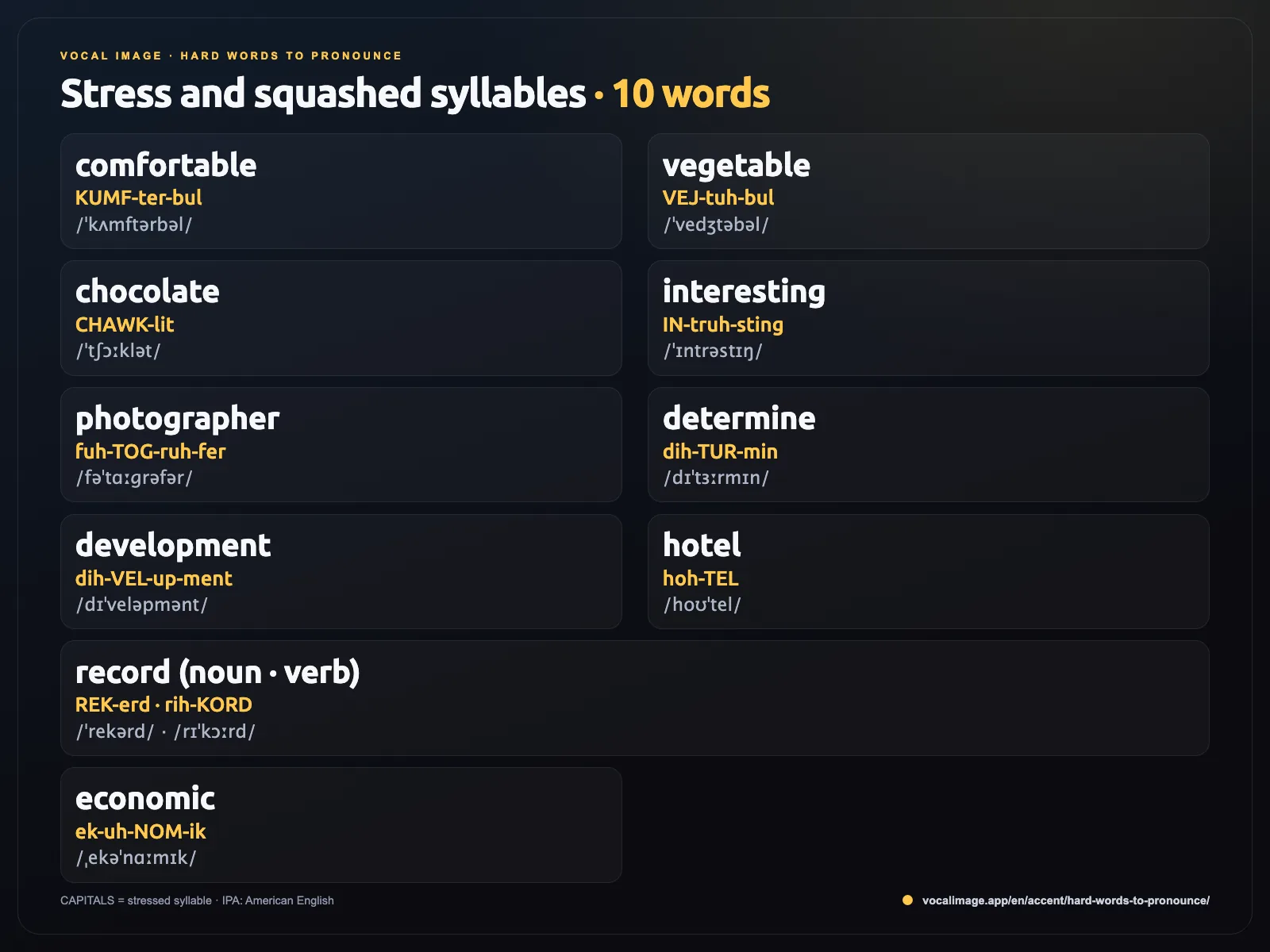
Stress and squashed syllables
Some words are hard not because of a sound but because of a beat. English squashes unstressed syllables (comfortable has three syllables in speech, not four) and moves the stress when a word grows: PHO-to-graph, pho-TOG-ra-pher, pho-to-GRAPH-ic. Put the stress in the wrong place and a perfectly pronounced word becomes hard to recognize.
| Word | IPA (US) | Say it like | Common slip |
|---|---|---|---|
| comfortable | /ˈkʌmftərbəl/ | KUMF-ter-bul | stress on TA: "com-for-TA-ble" |
| vegetable | /ˈvedʒtəbəl/ | VEJ-tuh-bul | "ve-ge-TA-ble" |
| chocolate | /ˈtʃɔːklət/ | CHAWK-lit | "cho-co-LATE", rhyming with late |
| interesting | /ˈɪntrəstɪŋ/ | IN-truh-sting | "in-ter-EST-ing" |
| photographer | /fəˈtɑːɡrəfər/ | fuh-TOG-ruh-fer | stress kept from photograph: "PHO-to-gra-pher" |
| determine | /dɪˈtɜːrmɪn/ | dih-TUR-min | "de-ter-MINE" |
| development | /dɪˈveləpmənt/ | dih-VEL-up-ment | "de-ve-LOP-ment" |
| hotel | /hoʊˈtel/ | hoh-TEL | "HO-tel" |
| record (noun · verb) | /ˈrekərd/ · /rɪˈkɔːrd/ | REK-erd · rih-KORD | the same stress for both |
| economic | /ˌekəˈnɑːmɪk/ | ek-uh-NOM-ik | stress kept from economy: "e-CO-no-mic" |
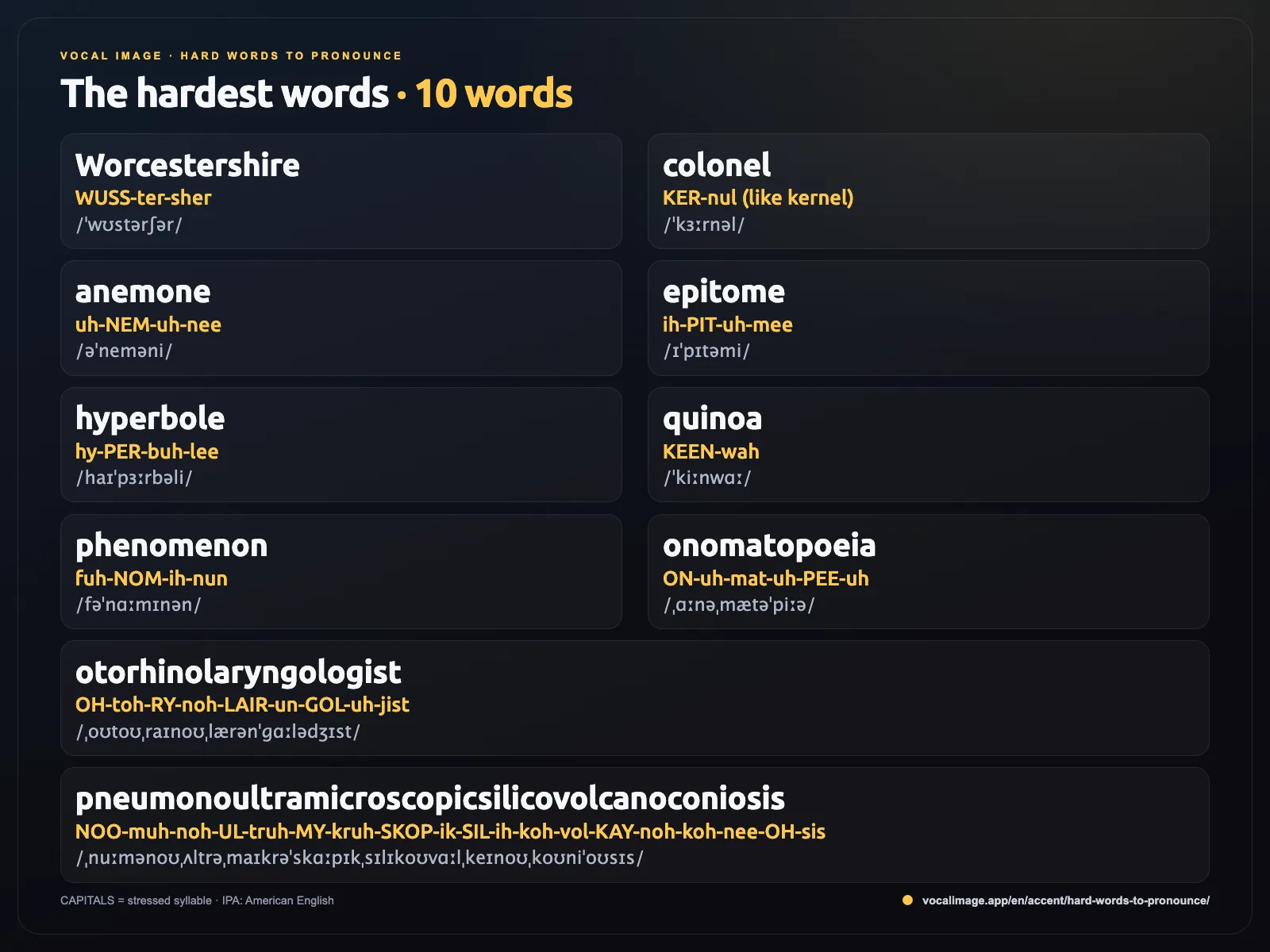
The hardest words to pronounce: even native speakers trip
These are the words that end up on every list of the hardest words to pronounce in English, and in party challenges: words that are hard to say even when you know exactly how they should sound. Most of them trip native speakers as well, so don't take them personally.
| Word | IPA (US) | Say it like | Common slip |
|---|---|---|---|
| Worcestershire | /ˈwʊstərʃər/ | WUSS-ter-sher | "wor-SES-ter-shire" |
| colonel | /ˈkɜːrnəl/ | KER-nul (like kernel) | "co-lo-nel" |
| anemone | /əˈneməni/ | uh-NEM-uh-nee | "AN-uh-mone" |
| epitome | /ɪˈpɪtəmi/ | ih-PIT-uh-mee | "EP-ih-tome" |
| hyperbole | /haɪˈpɜːrbəli/ | hy-PER-buh-lee | "HY-per-bowl" |
| quinoa | /ˈkiːnwɑː/ | KEEN-wah | "kwih-NO-uh" |
| phenomenon | /fəˈnɑːmɪnən/ | fuh-NOM-ih-nun | an M for the final N: "phe-NOM-e-mon" |
| onomatopoeia | /ˌɑːnəˌmætəˈpiːə/ | ON-uh-mat-uh-PEE-uh | "o-no-ma-to-POY-a" |
| otorhinolaryngologist | /ˌoʊtoʊˌraɪnoʊˌlærənˈɡɑːlədʒɪst/ | OH-toh-RY-noh-LAIR-un-GOL-uh-jist | losing your place halfway |
| pneumonoultramicroscopicsilicovolcanoconiosis | /ˌnuːmənoʊˌʌltrəˌmaɪkrəˈskɑːpɪkˌsɪlɪkoʊvɑːlˌkeɪnoʊˌkoʊniˈoʊsɪs/ | NOO-muh-noh-UL-truh-MY-kruh-SKOP-ik-SIL-ih-koh-vol-KAY-noh-koh-nee-OH-sis | running out of breath |
An otorhinolaryngologist is an ear, nose and throat doctor. The 45-letter giant at the bottom names a lung disease caused by breathing in very fine silica dust (the volcano is in there too). It was coined in 1935 as a puzzle-makers' joke, and it's still the longest word in major English dictionaries.
Why are some English words so hard to say?
Four things make a word hard, and most words on this page combine two of them:
- Spelling froze while the sounds kept moving. English spelling was largely fixed by early printers, while pronunciation kept shifting for centuries (the Great Vowel Shift alone reshuffled the long vowels). That's how knife kept a K nobody says.
- Borrowed words kept their foreign spelling. English first said colonel the way French and Spanish did at the time, as coronel. The spelling was later changed to match the Italian colonnello, but the R sound stayed. Quinoa arrived from Quechua through Spanish.
- English stacks consonants. Strengths has one vowel and up to seven consonant sounds. If your first language alternates consonants and vowels, as Japanese or Spanish mostly do, every cluster is a small tongue twister.
- Stress is unpredictable and it moves. Nothing in the spelling tells you that hotel is stressed at the end and photographer on the second syllable.
Difficult words to pronounce for non-native speakers
Which words are hard for you depends on your first language. Native speakers trip on Worcestershire. Learners usually trip on the short, everyday words in the first four groups, and which ones depends on the sounds their first language does and doesn't have:
| First language | Words to watch on this page | Why |
|---|---|---|
| Spanish | three, thought, months, strengths, sixth | no TH in most of Latin America; an "e" before S + consonant ("e-strengths") |
| Portuguese | three, thought, debt, texts | TH becomes F, T or S; an extra "ee" after a final consonant (Brazilian Portuguese: debt → "DET-chee") |
| Japanese, Korean | rural, really, world, library, squirrel | R and L are not separate sounds |
| Mandarin Chinese | months, sixth, twelfth, texts, strengths | few consonants allowed at the end of a syllable |
| Russian, Ukrainian, Polish | world, Wednesday, three, rhythm | W turns into V; TH into S, Z, T or F |
| German | world, Wednesday, clothes, breathe | W said as V; final consonants lose their voice |
| French | three, thought, hotel, hyperbole, photographer | no TH; silent H; stress drifts to the last syllable |
Hard words to pronounce for Spanish speakers
Spanish speakers make up one of the biggest groups of English learners, and the same few sounds catch most of them:
- TH: three, thought, months. Put the tongue between the teeth; it is not a T or an S.
- Short vs long vowels: ship / sheep, full / fool, live / leave. Spanish has five vowels, English about a dozen.
- S + consonant at the start: school, strengths, Spain. Start straight on the S, with no "e" in front.
- B vs V: very / berry. For V, the top teeth touch the lower lip.
For B and V, drill the B tongue twisters against the V ones. To train these contrasts one at a time, use minimal pairs like ship and sheep. A full plan for each language, with exercises, is in our guide to accent reduction.
How to pronounce any hard word in five steps
- Find the stress first. In a dictionary it's the syllable after the ˈ mark. A word with the right stress and a few wrong sounds is easier to understand than the other way round.
- Split it into syllables and say them slowly: WUSS · ter · sher.
- Listen once before you copy. Every major learner's dictionary has audio for both American and British English.
- Build back up. Slow, then normal speed, then inside a sentence. For long words, start from the end and add one syllable at a time (-sis, -osis, -niosis…). Teachers call it back-chaining, and it stops you running out of steam halfway.
- Record yourself and compare. Your own ear is a poor judge while you're speaking. To check how your English sounds overall, the free accent test takes 15 seconds.
Ready for whole phrases? Try the hard tongue twisters: the same sounds, at speed.
Practice sentences: hard words to say out loud
Read each line slowly, then twice at normal speed:
- The colonel's thorough report on the drought was the epitome of subtlety.
- On Wednesday, the sixth girl in the rural library read three texts about squirrels.
- It's interesting how comfortable the photographer seemed with the anemones.
- Though the dough was tough, the otorhinolaryngologist ate it anyway.
- Listen: the salmon in the Worcestershire sauce was a phenomenon.
Printable list
Download the 60 hard words as a PDF: all six tables on three printable pages. Tick off a group a day, and say each word out loud three times before you move on.
For more on how English accents differ, and which sounds give yours away, start at the accents hub.
What accent do people hear when you speak?
Read one short phrase — AI names your accent and the sounds that give it away. Free, no sign-up.
FAQ
There's no official winner. Lists usually name Worcestershire, colonel, anemone or otorhinolaryngologist, words whose spelling hides their sound. For learners, short words packed with consonants, like sixths or strengths, are often harder than any long one.
Sources
- Oxford Learner's Dictionaries — American English pronunciations, used for the IPA on this page
- Wikipedia — Pneumonoultramicroscopicsilicovolcanoconiosis: coined in 1935 by Everett M. Smith of the National Puzzlers' League
- Merriam-Webster — colonel and Etymonline — colonel: where the "kernel" pronunciation comes from
- Wikipedia — Great Vowel Shift
Explore more articles
Explore more challenges
Explore more voice tests
