
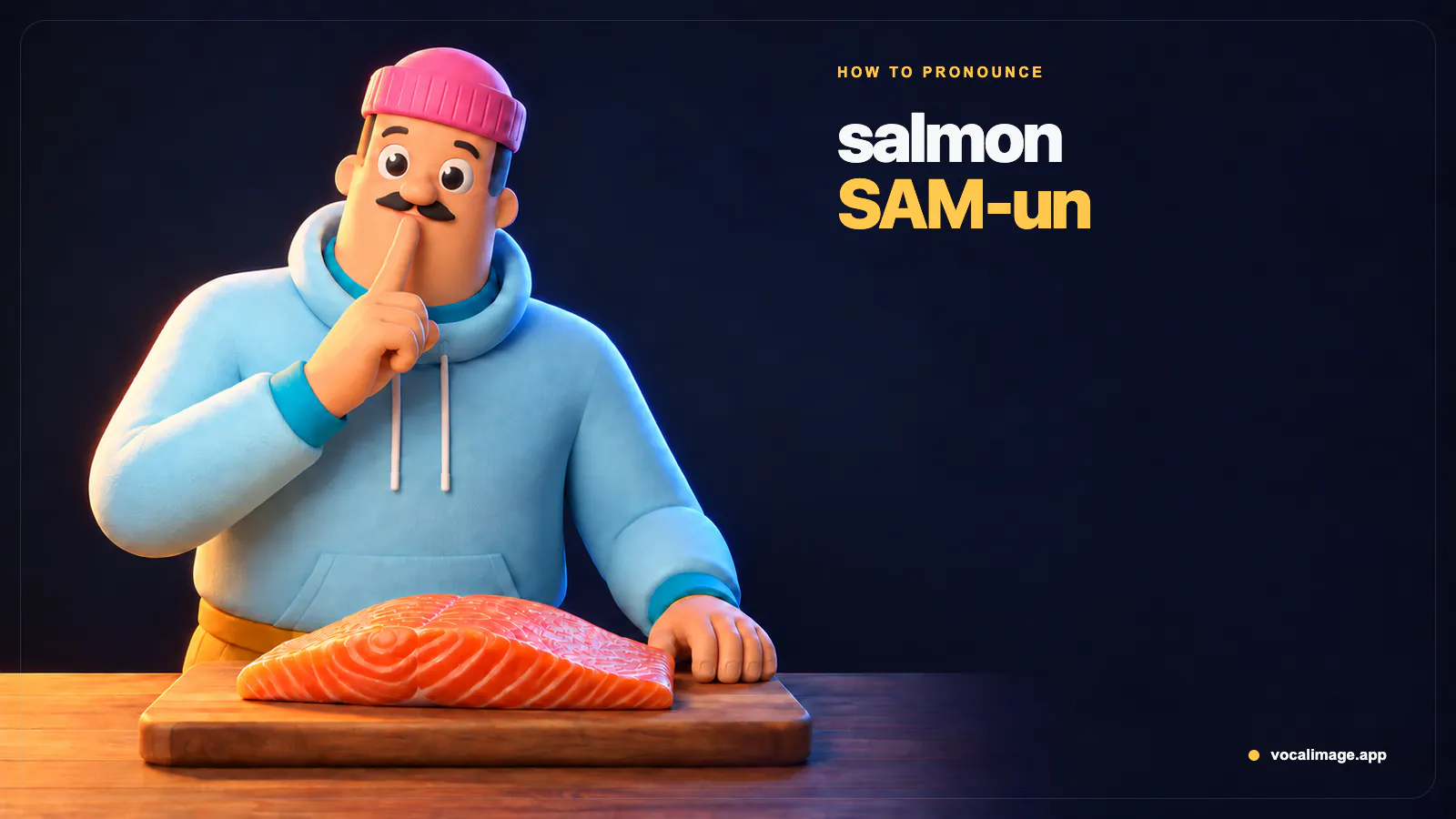
How to pronounce salmon
Short answer: say SAM-un (/ˈsæmən/), with a silent L: "Sam", like the name, plus a weak "un", as at the end of lemon. American and British English say it the same way. Cambridge and Oxford Learner's Dictionaries give /ˈsæmən/ for both, and Merriam-Webster, American Heritage, Dictionary.com and Collins list no other pronunciation. The L was added to the spelling in the 1500s to match Latin salmo, and the sound stayed the same.
Listen
Is the L in salmon silent?
Yes. Six of the seven dictionaries we checked give only SAM-un; Wiktionary also notes a regional salmon pronunciation with the L:
| Say it like | IPA | Who lists it |
|---|---|---|
| SAM-un | /ˈsæmən/ | Merriam-Webster, American Heritage, Dictionary.com (American); Cambridge and Oxford Learner's Dictionaries (British and American); Collins (British); Wiktionary |
| SAL-mun | /ˈsælmən/ | Wiktionary only: "sometimes" in the Southern US |
You may still hear SAL-mun. Wiktionary also lists an L in Philippine English and among non-native speakers, and Wikipedia's article on spelling pronunciations says a minority of speakers pronounce the L because it's written. We found no survey of how many. Salmon was also on a Dictionary.com list of 30 mispronounced words, reported by ABC7 in 2017 and based on how often people played each word's audio.
Names follow the fish: Merriam-Webster gives Idaho's Salmon River as SAM-un, and Wikipedia gives the surname of Alex Salmond, Scotland's former First Minister, as SAM-und.
So which should you say? SAM-un, in American and British English alike.
Why is salmon pronounced without the L?
Because English borrowed the word without one. Latin had salmo, but French had dropped the L by the time the word reached England: Old French saumon. Merriam-Webster dates the first known use of salmon in English to the 13th century, and Middle English writers usually spelled it samon or samoun.
The L came back on paper in the 1500s, when Renaissance scholars respelled borrowed words to look more like Latin. The same fashion gave debt its B and receipt its P. Searching early printed books, Ryuichi Hotta, who studies the history of English at Keio University, dates the change in salmon to the 1530s–1590s. The pronunciation didn't follow: in the 17th century, the lexicographer Elisha Coles still respelled the word sam-mun.
Other respelled words changed their sound. Fault got its L back in the 16th century; according to Etymonline, the letter stayed silent until the 18th, and today it's pronounced. Falcon got its L at the same time as salmon, and that L is now usually said too.
The vowel is unusual as well. In calm and half, an L that was once pronounced dropped out of speech, and British English says both words with a long "ah". Salmon keeps the short a of cat in British and American English, and the spelling scholar Edward Carney calls this al a one-off spelling of that vowel.
How to say salmon step by step
- Say "Sam", like the name: S, the short a of cat with your jaw open, then close your lips for M. Don't lift your tongue for an L on the way.
- Add a weak "un": a quick "uh" and N, like the end of lemon.
- Stress the first syllable: SAM-un. It rhymes with gammon and the end of backgammon.
Common mistakes:
- Saying the L. Spanish salmón (sahl-MOHN) and Italian salmone have an L and the stress near the end. In English, drop the L and stress the first syllable.
- A long "ah". Don't copy the British vowel of calm or half: dictionaries give British salmon the short a of cat.
Practice in a sentence
- I'll have the grilled salmon, please.
- Wild salmon swim back up the river where they hatched.
- Salmon is SAM-un, but salmonella is sal-muh-NEL-uh.
Compare other words with a tricky L. American pronunciations, from the Cambridge Dictionary:
| Word | The L | Say it like | IPA |
|---|---|---|---|
| salmonella | pronounced | sal-muh-NEL-uh | /ˌsæl.məˈnel.ə/ |
| falcon | added in the 1500s, now pronounced | FAHL-kun | /ˈfɑːl.kən/ |
| almond | US: with or without; UK: silent | AHL-mund | /ˈɑːl.mənd/ |
| calm | pronounced once, later lost | KAHM | /kɑːm/ |
| half | pronounced once, later lost | HAF | /hæf/ |
| walk | pronounced once, later lost | WAHK | /wɑːk/ |
More words whose spelling hides the sound: colonel, Worcestershire and February, or our list of 60 hard words to pronounce.
What is salmon?
Salmon are fish of the family Salmonidae: the Atlantic salmon (genus Salmo) and the Pacific species of the genus Oncorhynchus, such as Chinook, coho and sockeye. They typically hatch in fresh water, spend their adult lives at sea and return to the river where they were born to spawn. Salmon is an important food fish; Norway is the largest producer of farmed salmon, followed by Chile. Before the French word arrived, English called the fish lax; its Yiddish cousin laks gave American English lox in the 1930s.
Said it out loud? Hear how your English sounds overall — take the free accent test
15 secNow say a whole sentence
Read one short phrase — AI names the accent listeners hear and the sounds that give it away. Free, no sign-up.
FAQ
Yes. Merriam-Webster, American Heritage, Dictionary.com, Cambridge, Oxford Learner's Dictionaries and Collins give only SAM-un, /ˈsæmən/. Wiktionary notes SAL-mun as an occasional Southern US form.
Sources
- Merriam-Webster — salmon and salmonella, pronunciations, first known use, Salmon River
- Cambridge Dictionary — salmon and salmonella; Oxford Learner's Dictionaries — salmon, with word origin
- Dictionary.com — salmon; Collins — salmon; American Heritage Dictionary — salmon
- Wiktionary — salmon, salmón and saumon; Etymonline — salmon and fault
- Ryuichi Hotta, hellog (in Japanese) — the silent l in salmon, falcon and the vowel in salmon, 2026, quoting Carney (1994) and Dobson (1968)
- Wikipedia — Phonological history of English consonants, Spelling pronunciation, Salmon, Salmonella, Alex Salmond and Elisha Coles
- ABC7 — Dictionary.com's list of mispronounced words, October 2017
Explore more articles
Explore more challenges
Explore more voice tests
