
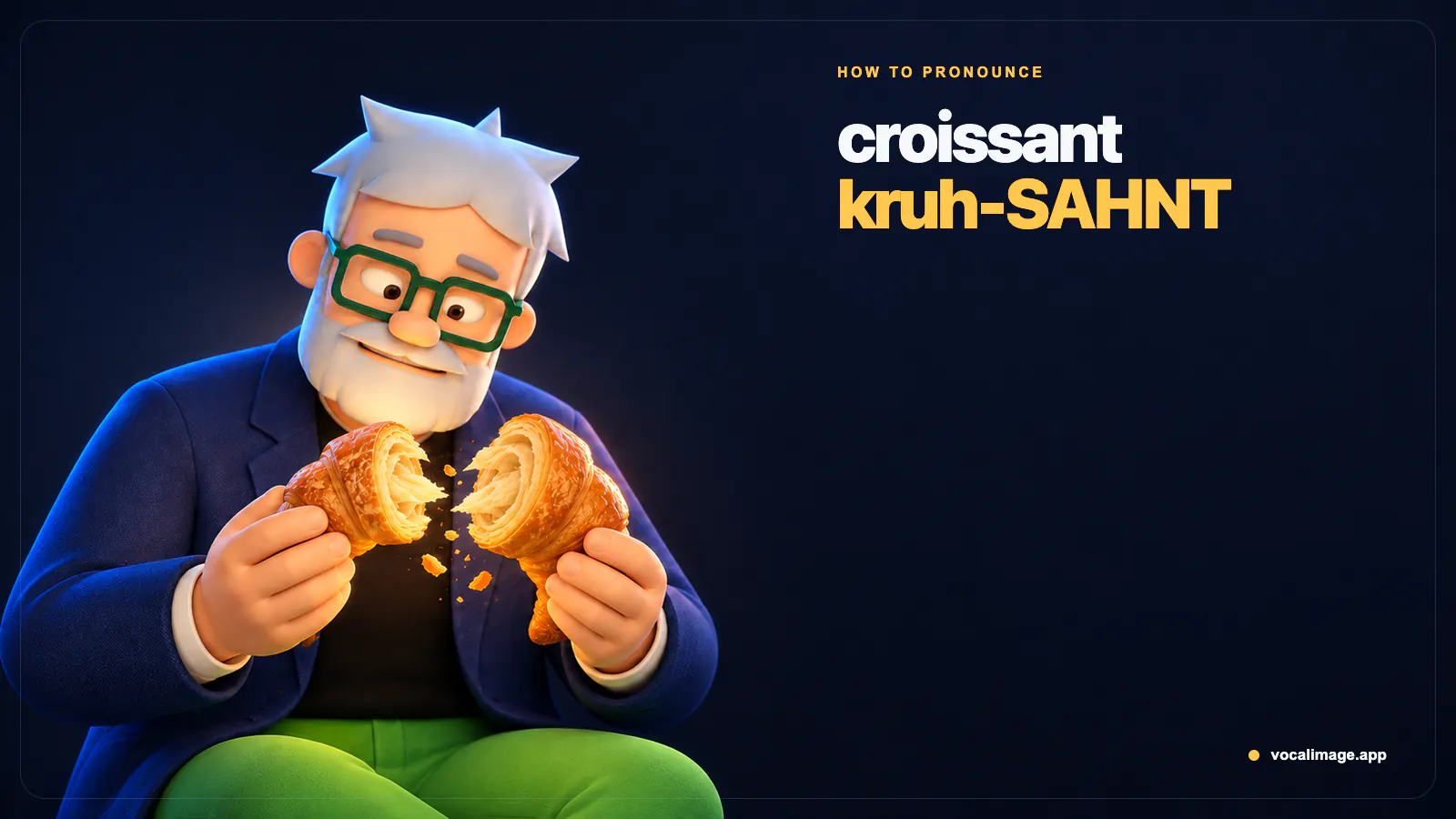
How to pronounce croissant
Short answer: in American English, say kruh-SAHNT (/krəˈsɑnt/), with the T: it comes first in Cambridge's and Oxford's American dictionaries, and Merriam-Webster lists it after kraw-SAHNT. The French-style krwah-SAHN, with a nasal vowel and no T, comes first in American Heritage and Dictionary.com. British dictionaries (Cambridge, Oxford Learner's Dictionaries) give KWASS-on (/ˈkwæsɒ̃/), stressed on the first syllable. In French, croissant is /kʁwa.sɑ̃/: krwah-SAHN, with a throaty R and a silent T.
Listen
Is it kruh-SAHNT or krwah-SAHN?
Both are correct in American English; British English has a third version:
| Version | Say it like | IPA | Who lists it |
|---|---|---|---|
| American, with the T | kruh-SAHNT, kraw-SAHNT | /krəˈsɑnt/, /krɔˈsɑnt/ | Cambridge's American Dictionary and Oxford's American dictionary (first); Merriam-Webster (first and second); American Heritage and Dictionary.com (second); Oxford Learner's Dictionaries (second for American English) |
| American, French-style | krwah-SAHN, kwah-SAHN | /krwɑˈsɑ̃/, /kwɑːˈsɑ̃ː/ | American Heritage and Dictionary.com (first); Cambridge's American Dictionary (second); Merriam-Webster (third); Cambridge English Dictionary (US) |
| American, no R but a T | kwah-SAHNT | /kwɑːˈsɑːnt/ | Oxford Learner's Dictionaries (first for American English); Oxford's American dictionary (second) |
| British | KWASS-on | /ˈkwæsɒ̃/ | Cambridge (UK), Oxford Learner's Dictionaries (British), Collins COBUILD; Collins English Dictionary has KRWUH-song, /ˈkrwʌsɒŋ/ |
| French | krwah-SAHN | /kʁwa.sɑ̃/ | Wiktionary |
Merriam-Webster, American Heritage and Dictionary.com list versions with and without the T and mark neither as wrong, and Smithsonian magazine wrote in 2015 that many English speakers use the French pronunciation.
The British form in Cambridge and Oxford stresses the first syllable and keeps a nasal ending, with no R and no T. That fits a wider pattern: in many French loanwords, American English stresses the last syllable and British English an earlier one. Cambridge has ballet as ba-LAY in American English and BAL-ay in British.
In a poll of 2,000 UK adults published in 2024 by the bakery brand St Pierre, croissant made the list of 30 foreign words Brits mispronounce or struggle with (a brand poll, not a scientific survey).
So which should you say? In the US, kruh-SAHNT is the safe choice, and krwah-SAHN is just as correct. In the UK, say KWASS-on.
Why is croissant pronounced differently?
Three French spelling rules explain the French version:
- oi is "wa", as in roi, "king", and foie gras.
- A final T is usually silent: tant, "so much", is just "tahn". The American kruh-SAHNT says it anyway, like English restaurant.
- an before a consonant is a nasal vowel, [ɑ̃]: one vowel said partly through the nose, not "a" plus N.
Croissant is French for "crescent", from the verb croître, "to grow", and Latin crescere. The Romans called the waxing moon luna crescens, the "growing moon", and later the word came to mean the moon's shape. English crescent comes from the same Old French word. Merriam-Webster dates the pastry's first known use in English to 1875.
How to say croissant step by step
- Start with "kr", as in cry. For the French-style version, round your lips into a W right after it: "krw".
- Keep the first syllable short: a weak "kruh", or "krwah" with the "ah" of father.
- Stress the second syllable: SAHN. (The British form stresses KWASS, with the A of cat.)
- Pick your ending: a light T for kruh-SAHNT. For krwah-SAHN, stop on the vowel and let air flow through your nose, with no N and no T.
Avoid "croy-SANT": none of the dictionaries above reads the oi as in boy. If you speak Spanish, cruasán already stresses the last syllable, like kruh-SAHNT; just use an English R, not a tapped one. Russian круассан has three syllables, but English croissant has two.
Practice in a sentence
- Can I get a butter croissant and a coffee, please?
- In Paris, ask for un croissant: krwah-SAHN, with no T.
- Is it kruh-SAHNT or KWASS-on? Both: one is American, the other British.
Then try other French food words. American pronunciations, from the Cambridge Dictionary:
| Word | The rule | Say it like | IPA |
|---|---|---|---|
| pain au chocolat | silent final T | pan oh SHAH-kuh-lah | /ˌpæn oʊ ˈʃɑː.kə.lɑː/ |
| beignet | silent final T | ben-YAY | /benˈjeɪ/ |
| foie gras | oi = "wa" | fwah GRAH | /ˌfwɑː ˈɡrɑː/ |
| restaurant | English keeps the T | RES-tuh-rahnt | /ˈres.tə.rɑːnt/ |
For more French food words, see how to pronounce charcuterie and macaron, or niche, another French word with two English pronunciations.
What is a croissant?
A croissant is a crescent-shaped roll of yeast dough layered with butter and folded several times, so it bakes up flaky. Its ancestor is the Austrian kipferl, known since at least the 13th century. Jim Chevallier, author of a book on the croissant's history, credits August Zang, an Austrian who opened a Viennese bakery in Paris in the late 1830s, with bringing it to France. The story that Vienna's bakers invented it to celebrate beating the Ottoman siege of 1683 is a legend: the Oxford Companion to Food traces its spread to Alfred Gottschalk, who told it in the first Larousse Gastronomique in 1938, set in Budapest in 1686. Today's flaky version dates from the early 20th century.
Said it out loud? Hear how your English sounds overall — take the free accent test
15 secNow say a whole sentence
Read one short phrase — AI names the accent listeners hear and the sounds that give it away. Free, no sign-up.
FAQ
In French, yes. In American English, Merriam-Webster, American Heritage and Dictionary.com list both kruh-SAHNT, with the T, and krwah-SAHN, without it. The British KWASS-on in Cambridge and Oxford has no T.
Sources
- Merriam-Webster — croissant, pronunciations and first known use
- Cambridge Dictionary — croissant, ballet, restaurant, pain au chocolat, beignet, foie gras
- Oxford Learner's Dictionaries — croissant and croissant (American English)
- Dictionary.com — croissant; American Heritage Dictionary — croissant; Collins — croissant
- Wiktionary — croissant (English and French), cruasán, круассан; Etymonline — crescent (archived copy)
- Wikipedia — French orthography, American and British English pronunciation differences, Croissant
- Smithsonian Magazine — Is the croissant really French?, Amanda Fiegl, April 2015 (archived copy)
- The Food Timeline — croissants, quoting Alan Davidson's Oxford Companion to Food (1999) and Jim Chevallier
- St Pierre UK — foreign words Brits mispronounce, December 2024
Explore more articles
Explore more challenges
Explore more voice tests
