Model card · Vocal Image ML team · Version 1.0 · November 2026
How our AI describes an English accent: the Accent Tagger model
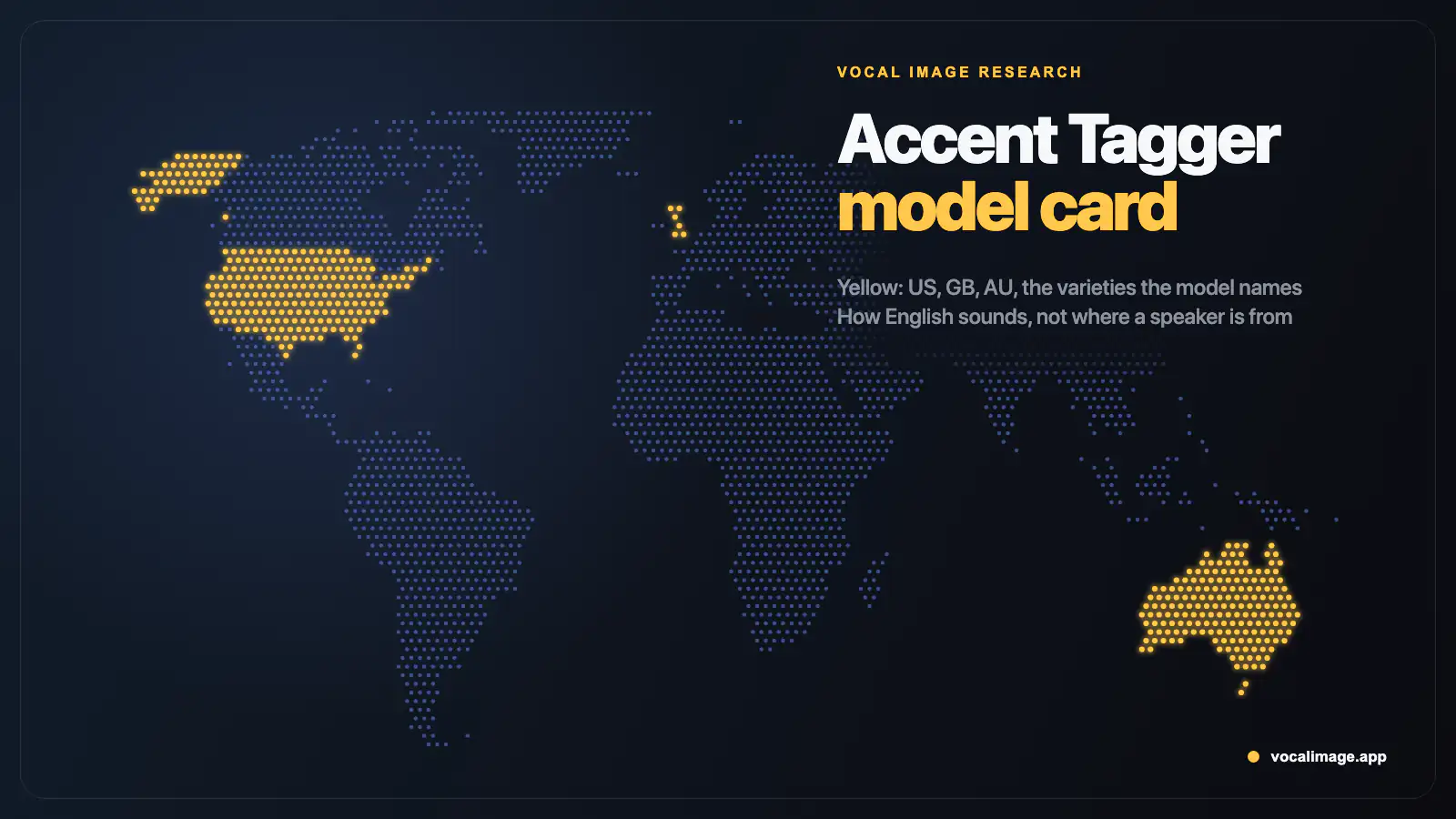
Accent Tagger listens to 15 seconds of English speech and in about a second answers three questions: does the English sound native, which variety of English a native-sounding speaker uses, and which accent group non-native English sounds closest to. It was trained on 2.4 million recordings of real learners, is more accurate than a general-purpose multimodal LLM on expert labels, and runs on a regular CPU.
What it outputs
One recording in, three answers out
Each answer comes with a display level: show, careful, maybe or hide. The product can name the accent directly, soften the wording, or say nothing when the model is not sure.
What it learned from
Real learners, checked by an expert
Real learners of English reading aloud in the mobile app and on the website: exactly the audio the product works with, from phones and browsers.
Before training, each label is checked against independent information about the speaker: their native language and country. The model learns mostly from the labels that this information confirms.
The model vs. a general-purpose LLM
More accurate than a general-purpose LLM
A direct comparison on the same task, with the same 15-second window. The baseline is a general-purpose multimodal LLM.
Where a general-purpose model goes wrong
The LLM's mistakes that the model avoids
Checked against the native language and country that speakers gave, and against the expert set.
| Accent Tagger | A general-purpose LLM | |
|---|---|---|
| Confident and wrong | Calibrated confidence, error ≤ 3.5%: an answer at 70% is right about 70% of the time. | 28%When the LLM says "German" with 90–100% confidence, the speaker’s native language or country confirms it in only 28% of cases (Slavic 24%, Spanish 39%). |
| An accent for native speakers | First decides whether the English sounds native; names German only with high confidence and in soft wording. | 74%of its "German" labels go to native English speakers; for "Russian", 50%. On the expert set, 1 of 27 "German" labels was confirmed. |
| Varieties of English | A separate US / GB / AU head, trained on where the speakers are from: macro-F1 0.88 per speaker on held-out native speakers. | 6.6%of native speakers from Australia get "Australian"; only 46% of native speakers from the US get "American". |
| Any audio gets a label | A two-step English check with explicit answers, "not English" or "too short"; 0 of 2,000 English test recordings rejected by mistake. | Names an accent for speech in any language and for a clip that is too short. |
| Repeatability | The same recording always gets one result; every answer includes the model version. | A generated answer can change from request to request and from version to version. |
| Data and cost | Runs as a separate service, the audio does not go to third parties; a fixed infrastructure cost. | A fee for every request. |
ROC-AUC shows how well the model separates native from non-native speech: 0.5 is chance, 1.0 is perfect. Macro-F1 combines how often the model is right when it names a variety and how many speakers of that variety it finds, averaged over US, GB and AU so that each variety counts equally.
When the model names an accent
How often a shown label is right
A label is shown only above its own confidence threshold; below it, the answer is hide. Measured on held-out recordings where the speaker's native language or country confirms the group.
How it works
The architecture in one diagram
A specialized speech model instead of a general-purpose chatbot: check the language, encode the voice once, answer three questions, calibrate.
What it gives the product
Benefits
Limits
What it doesn't do
- It works only with English. For other languages, it answers "not English" instead of guessing.
- It needs at least 3 seconds of speech and uses only the first 15 seconds.
- It names seven accent groups; every other accent goes to an eighth group, Other.
- For native-sounding speech, it knows three varieties: US, GB and AU.
- It works best on learners reading aloud.
- It describes how someone's English sounds. An accent is a feature of speech, so the answer should not be read as a statement about where a person is from or what their nationality is.
Privacy
Data and privacy
Accent Tagger was trained on recordings from Vocal Image users. See also our Privacy Policy.
Method: evaluation on held-out data, November 2026; the speakers in the test do not appear in training. The comparison on the expert set uses the 119 clips the expert could label, 57 of them from native speakers. The "native or not" baseline (≈70%) is the accuracy of a general-purpose LLM on the same task. The share of right labels among shown ones was measured on recordings where the speaker's stated native language or country confirms the group. Vocal Image · model v1.0 · data up to November 2026.
Sources
- Receiver operating characteristic (ROC-AUC), Wikipedia
- F-score (F1 and macro-F1), Wikipedia
- Probability calibration, Wikipedia
Citation
How to cite this page
You are welcome to use these results. Please credit Vocal Image and link to this page.
Vocal Image (2026). How our AI describes an English accent: the Accent Tagger model (version 1.0). https://www.vocalimage.app/en/studies/accent-model/
Read next
More model cards