
Model cards · Vocal Image ML team · November 2026
Our voice analysis models
We build our own speech models to describe how a voice comes across. This page covers three of them. Each one has a model card that explains what it outputs, what it learned from, how we tested it and where it falls short.
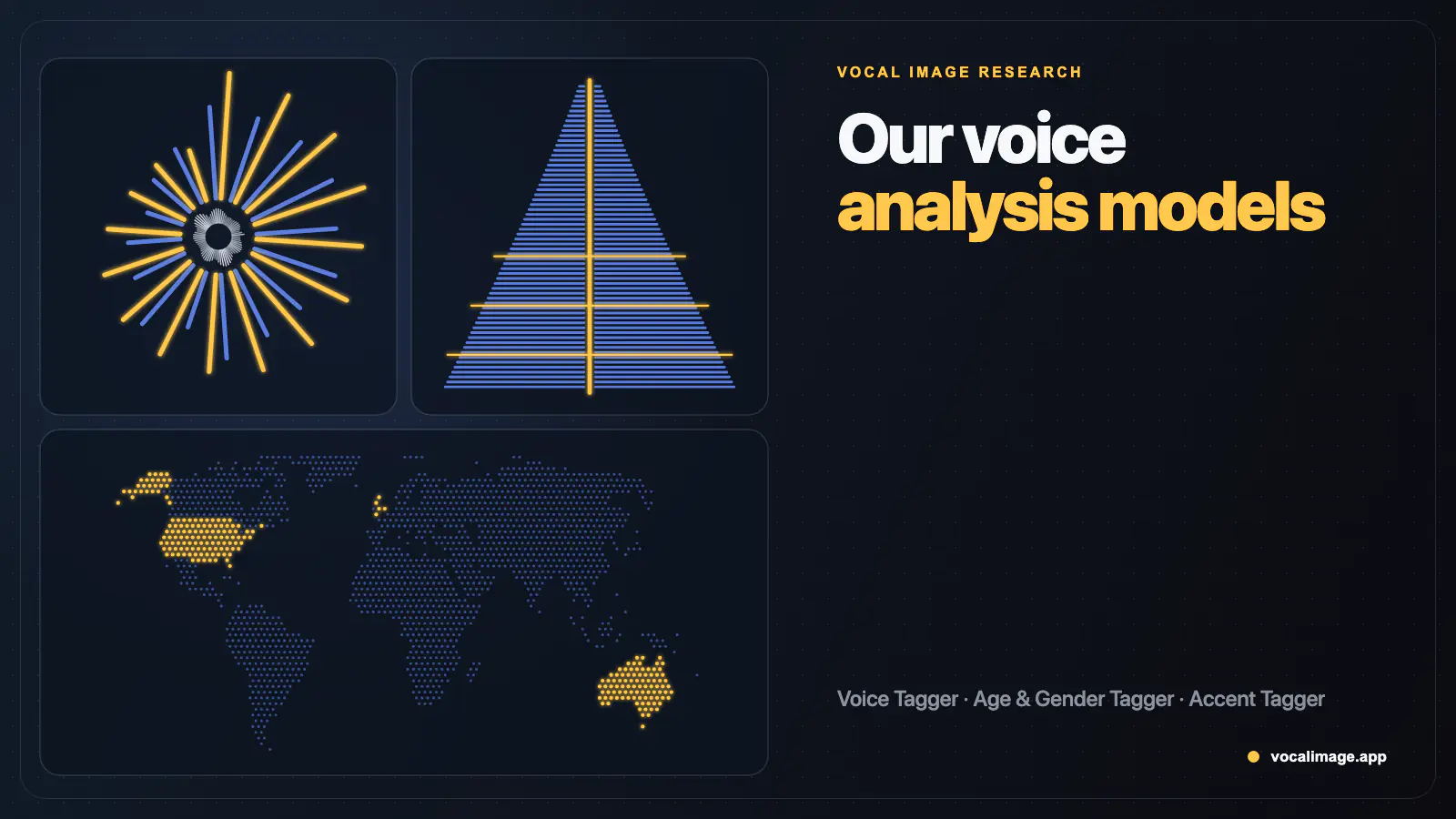
Voice Tagger
How listeners are likely to hear a voice, across 18 traits such as confident, warm or monotonous.
3.9M
ratings by 425,000 listeners
1.32×
the agreement of a same-size group of real listeners, in our test
Accent Tagger
Whether someone’s English sounds native, which variety it is (US, GB or AU), and which of eight accent groups it sounds closest to.
2.45M
labeled recordings of English speech
84%
right on native or not
Age & Gender Tagger
Whether a voice sounds male or female, and how old it sounds, in four age brackets.
886K
recordings for training and validation
0.994
ROC-AUC for gender. Age: exact bracket in 59% of cases, within one bracket in 95.5%
In common
What the three models have in common
Perception, not identityThey describe how a voice or someone’s speech sounds, not who a person is.
Real recordingsThey learned from recordings made in the Vocal Image app. Accent Tagger also learned from recordings made on our website.
Tested on new peopleEach one was tested on people it never heard in training.
Honest confidenceTheir probabilities are calibrated, and each model marks what it is less sure of, so that it can be shown more softly or hidden.
Our own serviceEach of them runs as our own service: the audio it analyzes is not sent to outside AI providers.