Model card · Vocal Image ML team · Version 1.0 · November 2026
How old and how male or female a voice sounds: the Age & Gender Tagger model
Age & Gender Tagger listens to a voice recording and tells how other people perceive the voice: whether it sounds male or female, with an honest "ambiguous" zone, and how old it sounds. It describes the voice, not the person: its answer is not a statement about anyone's actual gender or age. It was trained on 0.9 million recordings from Vocal Image users, tested on recordings that people labeled by ear, and runs on a regular CPU, without external APIs.
What it outputs
One recording in, two calibrated answers out
Each answer comes with a recommendation to show or hide it: if a recording is too short or too noisy, the product hides the estimate and asks the person to record again in a quiet place.
What it learned from
Real users' voices and a blind check by listeners
Recordings of exercises and voice tests in the Vocal Image app from 2026: the very audio the product works with, made on phone microphones. The labels come from the questionnaire, that is, the gender and age people gave in the app, and the quality is checked on a set that people labeled by ear.
The data is split by person: one person's voice is either in training or in the test, never in both. The results are counted both per recording and per person; per person, they are no worse.
The model vs current signals
More accurate than a leading multimodal LLM and than the questionnaire
A direct comparison with what the product can use today: a leading multimodal LLM and the user's questionnaire. For gender, the reference is the questionnaire on the large test and listeners on the gold set; for age, it is listeners.
Age by bracket
Where age can be heard, and where it can't
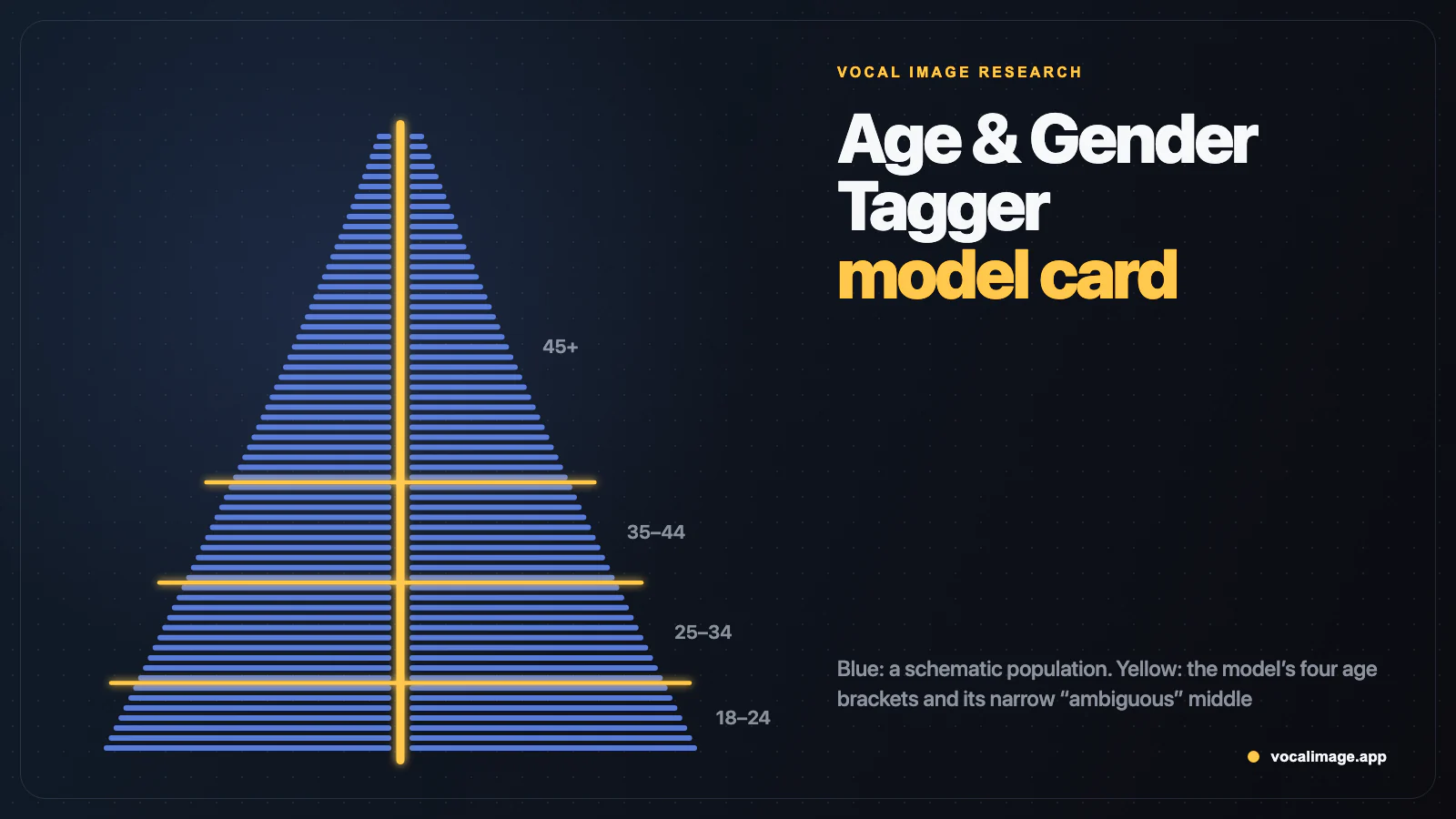
The model recognizes the outer brackets with confidence, while 25–34 and 35–44 are almost impossible to tell apart by ear. That is why age is shown as a range: within one bracket, the model is right in 92–97% of cases in every age group.
What it replaces
Why not a multimodal LLM and not a pitch threshold
The model compared with a multimodal LLM and a pitch threshold, row by row.
| Age & Gender Tagger | A multimodal LLM | A pitch threshold | |
|---|---|---|---|
| Gender errors | 0.6%of male–female pairs in the wrong order (ROC-AUC 0.994) | 4.8%ROC-AUC 0.952: 8 times more errors | 4.4%ROC-AUC 0.956: one 161 Hz threshold for everyone |
| Ambiguous voices | An "ambiguous" zone, with thresholds tuned on listeners’ labels | Always answers "sounds male" or "sounds female" | Always answers "sounds male" or "sounds female" |
| Scale | A calibrated probability: fits a progress chart | Numbers without calibration | Only yes or no |
| Age | Four brackets and a range; within one bracket in 95.5% of cases | No | No; the old age test is right in 35% of cases |
| Repeatability | One recording always gets one answer; the model version is in every answer | The provider controls the version | Repeatable, but coarse |
| Data and cost | Our own service, the audio does not go to third parties; a fixed cost | Paid per request | Free |
How it works
The architecture in one diagram
A specialized voice model that listens to the timbre, not the words: one encoder, two heads and a calibration step.
What it gives the product
Benefits
Limits
What it doesn't do
- It describes how a voice sounds, not a person's gender or age; in the product, results are worded only as "your voice sounds…".
- It is not meant for targeting, advertising, moderation or identity checks.
- It learned age from the questionnaire: against listeners, it matches the exact bracket in 42.9% of cases and comes within one bracket in 89.5%, slightly better than the questionnaire itself.
- Four age brackets: 55 and older is part of 45+, there is no age in years, and children's voices are not supported.
- It needs at least 3 seconds of speech; it takes recordings of up to 60 seconds and listens to the first 15.
- The "ambiguous" zone is narrow: of 10 voices that listeners found ambiguous, it caught 2.
Privacy
Data and privacy
Age & Gender Tagger was trained on voice recordings from Vocal Image users, with the gender and age they gave in the app as labels. See also our Privacy Policy.
Method: evaluation on a held-out part of users, November 2026; people from the test do not appear in training. Gender: ROC-AUC against the questionnaire on 30,454 test recordings, and a direct comparison with a leading multimodal LLM and a 161 Hz pitch threshold (6,887 test recordings). Gold set: 300 recordings labeled blind, by ear; 290 had a clear gender to listeners and 275 a clear age bracket. Calibration: temperatures on validation, "ambiguous" thresholds on the gold set. Speed: a load test on AWS Fargate, 2 vCPU, 15-second recordings, 0.3 recordings per second. Vocal Image · model v1.0.0.2026-11-19 · data up to November 2026.
Sources
- Receiver operating characteristic (ROC-AUC), Wikipedia
- Probability calibration, Wikipedia
- WavLM: Large-Scale Self-Supervised Pre-Training for Full Stack Speech Processing, arXiv
Citation
How to cite this page
You are welcome to use these results. Please credit Vocal Image and link to this page.
Vocal Image (2026). How old and how male or female a voice sounds: the Age & Gender Tagger model (version 1.0). https://www.vocalimage.app/en/studies/age-gender-model/
Read next
More model cards