Model card · Vocal Image ML team · Version 1.0 · November 2026
How our AI rates your voice: the Voice Tagger model
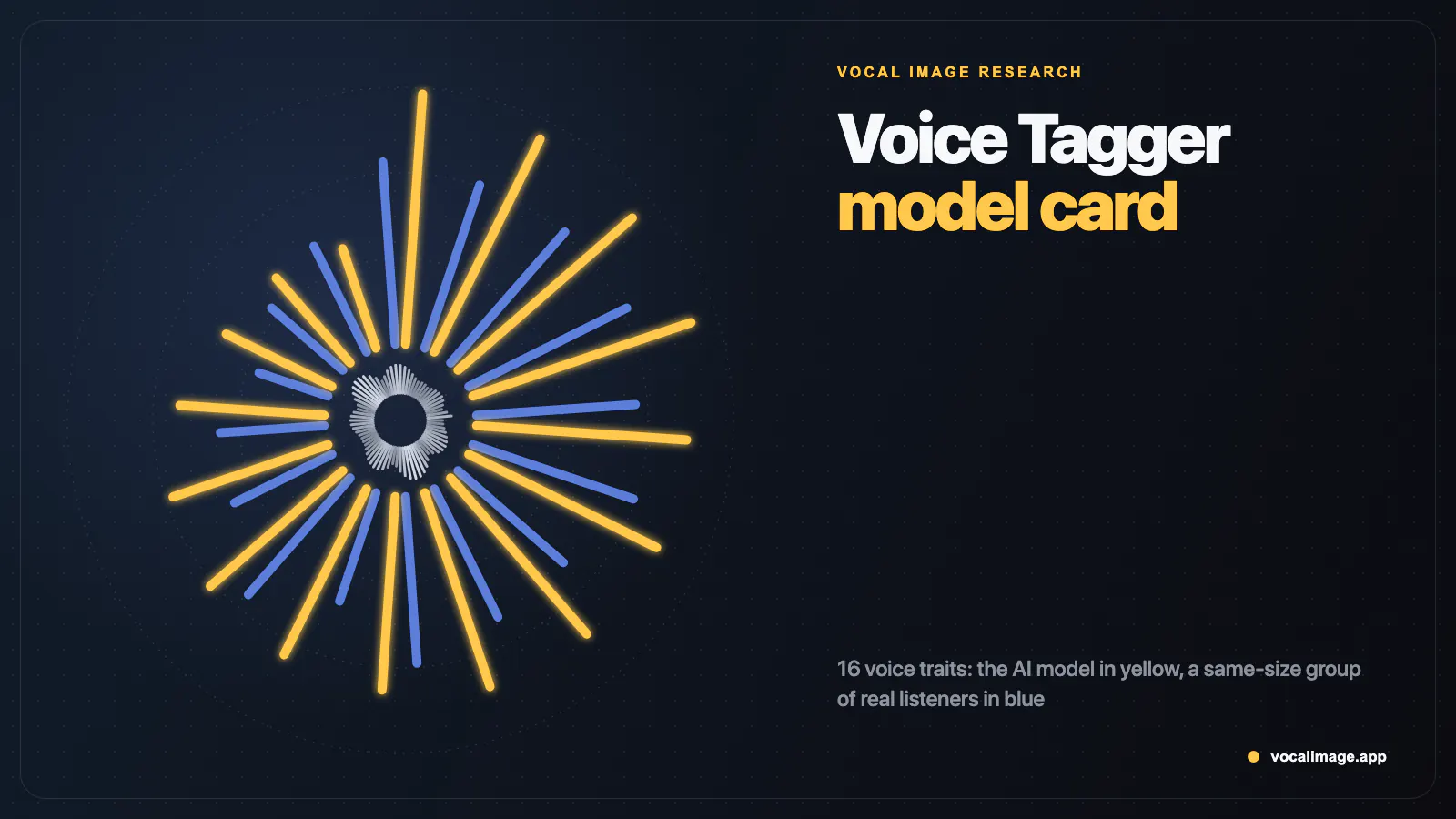
When you rate your voice in Vocal Image, the trait percentages in your AI Rating come from Voice Tagger. It listens to a voice recording and in about a second says how people are likely to hear the voice: confident, deep, monotonous, mumbled. It covers 18 perceptual traits, each on a clear scale: how many out of 10 listeners would pick it.
What it measures
18 traits, each as a share of listeners
Voice Tagger listens to 6–60 seconds of speech and predicts how listeners are likely to hear the voice across 18 perceptual traits. One of them, AI-generated, is only a weak internal signal and is not shown to users. For each trait, it predicts the share of listeners who would pick that word. In the app, a trait appears as a percentage: 62% confident means that about 62 out of 100 listeners would hear you as confident.
It describes perception, not quality. There is no "good" or "bad" voice in its output, and with the same model version the same audio file gets the same result on every run.
Why a model
A read for every recording
In Voice Arena, people rate each other's voices with tags. But 71% of recordings used to get only one or two ratings, and one or two people can't tell you how a voice comes across. Voice Tagger learned from millions of ratings, so every recording gets a stable read, including one that nobody has rated yet.
What it learned from
Millions of real human ratings
The model learns from how real people perceive voices in the Vocal Image app: a user listens to someone else's recording and marks the traits that fit. These are not synthetic labels and not a single expert's opinion.
Before training, we removed spam and random clicks and gave more weight to listeners whose ratings agree with others. After cleaning, 94% of the listens remained.
The model vs. live listeners
How the model compares with the listeners it learned from
We split all listeners at random into two independent halves and trained a version of the model on the first half's ratings only. Then we compared who better predicts the second half's opinion: that model, or the first half's real listeners. The longer the bar, the stronger the agreement (Spearman correlation).
- 1Split the listenersAll listeners are split at random into two halves.
- 2Train on the first halfA version of Voice Tagger learns from the first half’s ratings only.
- 3Pick new voices3,465 recordings with at least 10 ratings each; the speakers were not in the training data.
- 4Predict the other halfWho predicts the other half’s opinion better: the model or the first half’s listeners?
We ran the comparison on 3,465 recordings with at least 10 ratings each. The speakers in these recordings were not in the training data. The measure is rank correlation (Spearman): for each trait, how closely the ranking of recordings by the prediction matches their ranking by the share of listeners who chose that tag.
The results:
- The model's agreement with the other half was 1.32 times that of the first half's listeners.
- On 15 of the 16 traits we publish (all but AI-generated), it predicted the other half better than the first half's listeners did; with the two traits we don't publish, 17 of 18.
- It reaches about 80% of the theoretical ceiling: the best score a predictor could reach, estimated from how closely the two halves of listeners agree with each other.
- With a ROC-AUC of 0.88, it separates voices that listeners clearly tag with a trait from all other voices (0.5 is chance, 1.0 is perfect).
Each half holds only part of a recording's ratings, so the human group in this comparison is small. A larger group of listeners would agree more closely with the other half.
In plain words: the model's read of a voice is closer to what the other half of listeners say than the combined opinion of the same number of real listeners.
The model gives AI-generated only as a weak internal signal; it is not shown to users.
Results by trait
Agreement with the other half of listeners (Spearman's ρ) on the 3,465 test recordings:
| Trait | Voice Tagger | Same-size listener group | Model ÷ group |
|---|---|---|---|
| Confident | 0.586 | 0.427 | 1.37× |
| Clear | 0.556 | 0.402 | 1.38× |
| Expressive | 0.541 | 0.406 | 1.33× |
| Deep | 0.538 | 0.412 | 1.31× |
| Slow (pace) | 0.492 | 0.372 | 1.32× |
| Mumbled | 0.490 | 0.396 | 1.24× |
| Weak | 0.484 | 0.327 | 1.48× |
| Disfluent | 0.478 | 0.334 | 1.43× |
| Childlike | 0.453 | 0.390 | 1.16× |
| Monotonous | 0.433 | 0.267 | 1.62× |
| Fast (pace) | 0.411 | 0.362 | 1.14× |
| Warm | 0.382 | 0.254 | 1.50× |
| Authentic | 0.338 | 0.243 | 1.39× |
| Nasal | 0.276 | 0.170 | 1.62× |
| Harsh | 0.263 | 0.221 | 1.19× |
| AI-generated (internal signal) | 0.245 | 0.276 | 0.89× |
We publish results for 16 of the model's 18 traits. The other two, about accent and attractiveness, are left out: results like these are too easy to read as judgments about a person rather than about how a recording sounds. Both of them also predicted the other half better than the listener group, which is why the model wins on 17 of the 18 traits.
How it works
The architecture in one diagram
The model looks at a voice from three sides at once and brings it all together into 18 calibrated scores.
Comparison
Why not a general-purpose LLM
General-purpose multimodal models can describe audio in words. Our task is different: to measure how people perceive a voice, the same way for every recording. Below, the two approaches are compared by design, not by the results of a joint test.
| Voice Tagger | A general-purpose LLM | |
|---|---|---|
| What it learned from | Millions of ratings of how voices are perceived, from 425,000 real listeners | General internet data; no special labels for how voices are perceived |
| What it answers | 18 numbers: the share of listeners who would mark each trait | Free text; numbers have to be asked for and pulled out of the answer |
| Repeatability | One recording gets the same result on every run | The answer can change from request to request and from version to version |
| Proven accuracy | Measured on thousands of recordings against independent listeners: 1.32 times the agreement of a same-size live panel | No published metrics for voice perception |
| Tracking progress | One scale: one person’s recordings can be compared over months | The wording drifts, so changes are hard to compare |
| Data | Runs as a separate service; the audio does not go to outside AI providers | The audio is sent to the provider’s cloud |
| Cost | Fixed infrastructure, whatever the length of the answer | A fee for input and output tokens |
What it gives the product
Benefits
Limits
What it doesn't do
- It describes how a voice is perceived, not whether it is good or bad.
- It isn't a deepfake detector: AI-generated is only a weak internal signal. It predicts how many listeners would say a voice sounds artificial, which is not evidence that a recording is synthetic, and it is the one trait where the model did worse than real listeners.
- It's built for speech, not singing.
- Most of its training data is in English, Russian and Spanish, so it is expected to work best there. We don't publish results by language yet.
- Some traits are harder to agree on, for listeners and the model alike (see the table above). Traits the model predicts less reliably are shown more softly (as "possibly") or hidden.
- Background noise and your microphone can change the result, so record in a quiet place.
Privacy
Data and privacy
Voice Tagger was trained on recordings and ratings from Vocal Image users, as described in our Privacy Policy. Voice Tagger runs as our own service: the audio it analyzes is not sent to outside AI providers.
Method: Spearman correlation between the prediction and the share of listeners who chose the tag; recordings with 10+ ratings; the authors of the test recordings were excluded from training. The theoretical ceiling was calculated from the agreement between two independent halves of listeners. Vocal Image · model v1.0 · data up to November 2026.
Sources
- Spearman's rank correlation coefficient, Wikipedia
- Receiver operating characteristic (ROC-AUC), Wikipedia
Citation
How to cite this research
You are welcome to use these results. Please credit Vocal Image and link to this page. You can copy the citation or download the results as a CSV file.
Vocal Image (2026). How our AI rates your voice: the Voice Tagger model (version 1.0). https://www.vocalimage.app/en/studies/voice-rating-model/
Hear how you come across
Read a short text aloud in the app — your AI Rating shows how listeners are likely to hear you.
Read next
More model cards